

How to Adapt to Change: Lessons From an Olympic Underdog
Learn how to adapt to change with Olympic athlete Devon Harris. Discover 3 core capabilities that build resilience and adaptability .
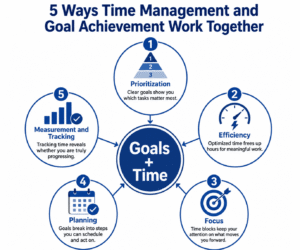
In the hustle and bustle of modern life, achieving your goals can often feel like an uphill battle. However, there’s a dynamic duo that can significantly enhance your chances of success: time management and goal achievement. When these two forces work in harmony, they become a powerful strategy for reaching your aspirations efficiently and effectively.
Time is perhaps the most precious resource we have, and how we manage it can profoundly impact our ability to achieve our goals. Here’s how time management and goal achievement are interconnected:
Now that we understand the connection between time management and goal achievement, let’s explore some practical strategies to integrate these two elements effectively:
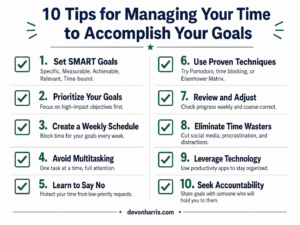
Time management without clear goals is just busyness. Goals without a time structure are just wishes. SMART goals are the bridge between the two — a framework that forces you to define what you want and when you’ll achieve it, so your time always has a destination.
A SMART goal for time management is:
A weak goal sounds like: “I want to get better at managing my time.”
A SMART goal sounds like: “I will complete my three highest-priority work tasks before noon every weekday for the next four weeks, tracking completion in a daily planner.”
Notice the difference. The second version tells you exactly what to do, how to measure success, and when the goal ends. That clarity removes the friction that causes most people to abandon their intentions.
Use this fill-in structure to build your own:
“I will [specific action] for [measurable amount of time or output] by [deadline], in order to [relevant outcome].”
Example: “I will block 90 minutes every morning from 7–8:30am for deep work on my top project, Monday through Friday, for the next 30 days, in order to complete the first draft of my business plan.”
Once your SMART goal is written, schedule it. Put it in your calendar as a non-negotiable appointment — with yourself.
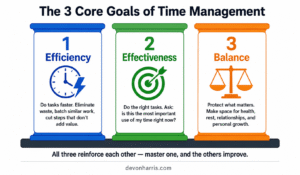
The three core goals of effective time management are efficiency, effectiveness, and balance — and understanding the difference between them changes how you approach your day entirely.
1. Efficiency — doing tasks faster
Efficiency is about reducing the time and effort it takes to complete what’s already on your plate. This includes eliminating distractions, batching similar tasks, using productivity systems, and cutting out steps that don’t add value. An efficient person finishes the same work in less time.
2. Effectiveness — doing the right tasks
Effectiveness is about choosing what to work on in the first place. You can be highly efficient at the wrong things and still fail to reach your goals. Effective time management means regularly asking, “Is this the most important use of my time right now?” It is the difference between being busy and being productive.
3. Balance — protecting time for what matters most
The third goal is often overlooked: using time management to create space for health, relationships, rest, and personal growth — not just work output. Without balance, efficiency and effectiveness eventually burn out the very person doing the work.
It is a theme I come back to with teams as a professional development speaker.
All three goals reinforce each other. Get more efficient, and you free up time. Use that time effectively, and you make real progress. Protect time for balance, and you sustain the energy to keep pushing.
Mastering time management is not just about working harder but working smarter. By effectively managing your time, you create the space and focus needed to work toward your goals. Conversely, setting clear, well-defined goals helps you prioritize tasks and allocate your time efficiently. Together, these strategies form a dynamic partnership that can propel you toward your aspirations and lead you to a more fulfilling and successful life.
For further insights into achieving your goals, check out my previous blog posts on The Power of Visualization and The Power of Affirmations.
Keep On Pushing!
A SMART goal for time management is a goal that is Specific, Measurable, Achievable, Relevant, and Time-bound — structured so you know exactly what you’re working toward and by when. For example: “I will spend 60 minutes every evening, Monday to Friday, working on my online course for the next six weeks.” This kind of goal removes ambiguity and gives your daily time blocks a clear purpose.
The most effective approach combines three habits: First, break each goal into weekly and daily actions so you always know what your next step is. Second, schedule those actions as fixed time blocks in your calendar rather than leaving them on a to-do list. Third, review your progress weekly — if you didn’t complete a block, reschedule it immediately rather than letting it drift. Goals get accomplished when time is actively assigned to them, not simply hoped for.
The three basic goals of time management are efficiency (completing tasks faster with less wasted effort), effectiveness (focusing on the tasks that matter most to your goals), and balance (protecting time for health, rest, and personal priorities). True time management isn’t only about productivity — it’s about designing a schedule that moves you toward your goals without burning you out.
Devon tailors every keynote to your audience, your theme and the challenge in front of them.
Learn how to adapt to change with Olympic athlete Devon Harris. Discover 3 core capabilities that build resilience and adaptability .
Learn how to focus on the solution not the problem with Devon Harris. The Olympic mindset shift that turns every obstacle into an opportunity.
Devon Harris shares Olympic lessons on staying positive during hard times and finding real growth inside the struggle.