How to Adapt to Change: Lessons From an Olympic Underdog
Learn how to adapt to change with Olympic athlete Devon Harris. Discover 3 core capabilities that build resilience and adaptability .
The night before our Olympic bobsled debut, I couldn’t sleep.
My teammates were out cold in the next beds while I lay staring at the ceiling of our Calgary hotel room, my mind doing what minds do at midnight before the biggest day of your life — going to every dark place it could find. Who was I kidding? A kid from the Kingston slums, no winter sports tradition, no blueprint, no guarantee of anything except that the next morning was coming whether I was ready for it or not.
I didn’t know how to stay positive that night. I don’t think I did stay positive, not in the way the phrase usually gets used. What I did was something different — something I’ve spent years trying to understand and put into words so that other people can use it too.
I chose to stay in the process instead of fleeing into the outcome.
That distinction is everything. And it is what this piece is about.
Let me get something out of the way first, because I think a lot of well-meaning advice on positivity does more harm than good.
Staying positive does not mean pretending things aren’t hard. It does not mean smiling through pain, dismissing real fear, or telling yourself that everything happens for a reason while you’re still bleeding from the fall. That version of positivity is brittle. It cracks the moment real difficulty shows up — and real difficulty always shows up.
What a genuine positive mindset actually means is this: the ability to hold two things at once. This is genuinely hard right now, and something useful is happening inside this difficulty. Not instead of the pain. Alongside it.
The athletes I competed alongside in Calgary who went on to sustained excellence were not the ones who never doubted. They were the ones who could doubt and keep moving at the same time. That is a completely different thing. Doubt with momentum is growth. Doubt that stops you is just fear with a longer name.

Our crash rate during training was — I’ll be honest — alarming enough that other teams started scheduling their practice runs around ours. They weren’t being polite. They were protecting themselves from the chaos that followed our sled down the track.
Every crash was a full-body lesson. The ice at speed is not forgiving and it does not care about your dignity. But something happened after enough of those crashes: we stopped fighting the fact of them and started listening to them. What did the sled do in that corner? What were we feeling two seconds before it went wrong? What would we change?
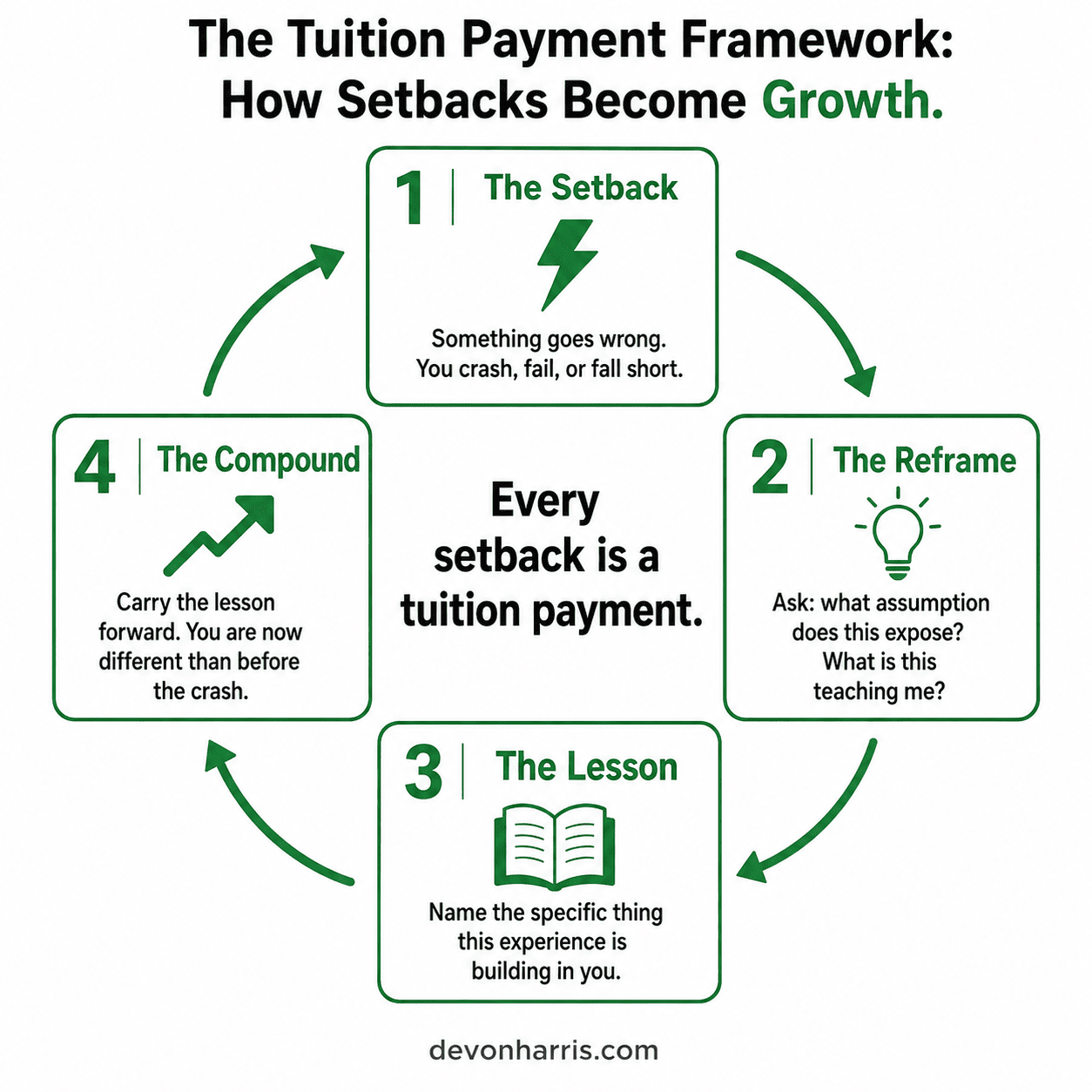
We started calling the crashes tuition payments. We had enrolled in a school we did not choose, on a curriculum we could not fast-forward, and every wipeout was us paying for an education that no classroom could provide. Once we named them that, the crashes stopped being evidence that we didn’t belong and started being evidence that we were learning.
That reframe did not make the crashes painless. It made them purposeful. And purposeful pain is survivable in a way that meaningless pain simply isn’t.
This is what difficult times are actually doing when you’re inside them and can’t see the shape of it yet. They are building things in you that success cannot build — the kind of resilience that has been tested rather than assumed, the kind of patience that has been earned rather than chosen, the kind of self-knowledge that only comes from finding out what you do when things genuinely go wrong and the easy exit isn’t available.
A positive outlook on hard times doesn’t come from denying their difficulty. It comes from trusting that the difficulty has a return on investment — even when you can’t see the return yet.
Here is the practical problem with most advice about mindset: it is usually given by people who are standing on the other side of the hard part, looking back. From over there, it is easy to say “trust the process” or “embrace the struggle.” It is considerably harder to do those things when you are actually in the middle of the struggle and cannot see the other side from where you are standing.
So let me try to be more specific about what actually works.
The single most effective mindset shift I know is changing the question you are asking. When we are inside difficulty, our minds default to outcome questions: Will this work out? Will it be worth it? Am I going to make it? Those questions have no good answers in the middle of the process because the middle of the process is precisely where you cannot know how it ends.
Switch to process questions instead. What is this teaching me right now? What is being built in me by this specific experience that could not be built any other way? What would I do differently in the next ten minutes, not the next ten months?
Process questions have answers you can actually use today. They redirect your attention from a future you cannot control to a present you can engage with. That shift — from outcome-focused to process-focused — is the practical core of what it means to change your mindset during hard times. It is not about feeling better. It is about being more useful to yourself.
The second thing that genuinely helps is reframing setbacks as information rather than verdicts. A setback is not the universe telling you that you don’t belong or that you’ve already failed. It is a piece of data. Something didn’t work. Why didn’t it work? What does that tell you about what needs to change? When you treat a setback as a verdict, it stops you. When you treat it as information, it moves you forward.
We crashed. We learned why. We adjusted. We got back on the track. That is not a motivational poster — that is a description of a functional process for staying positive during difficult times that actually works under real pressure.
The most important lesson from failure is one most people miss because they are too busy trying to get past the failure to pay attention to what it is saying.
Failure reveals your assumptions. Specifically, it reveals which of your assumptions were wrong. And wrong assumptions, once corrected, are worth more than almost any success — because they change the entire foundation you are building on going forward.
When our sled went sideways in training, it was almost always because one of us had assumed something that wasn’t true. Assumed the corner was slower than it was. Assumed the ice condition was the same as yesterday. Assumed a teammate would compensate in a way they didn’t. The crash wasn’t the problem. The assumption was the problem. The crash just made the assumption visible.
In your own life, the failures that sting the most are usually the ones that expose an assumption you were most attached to. A business idea that didn’t work because the market didn’t actually want what you were selling. A relationship that ended because you assumed connection could survive without investment. A health goal that collapsed because you assumed willpower was a renewable resource that didn’t need to be managed.
Those exposures are painful precisely because they are true. But a corrected assumption is a repaired foundation. You build everything after that on something more solid than what you had before. That is not a consolation prize for failing. That is the actual return on investment that failure offers if you are willing to look for it rather than just waiting for the pain to go away.
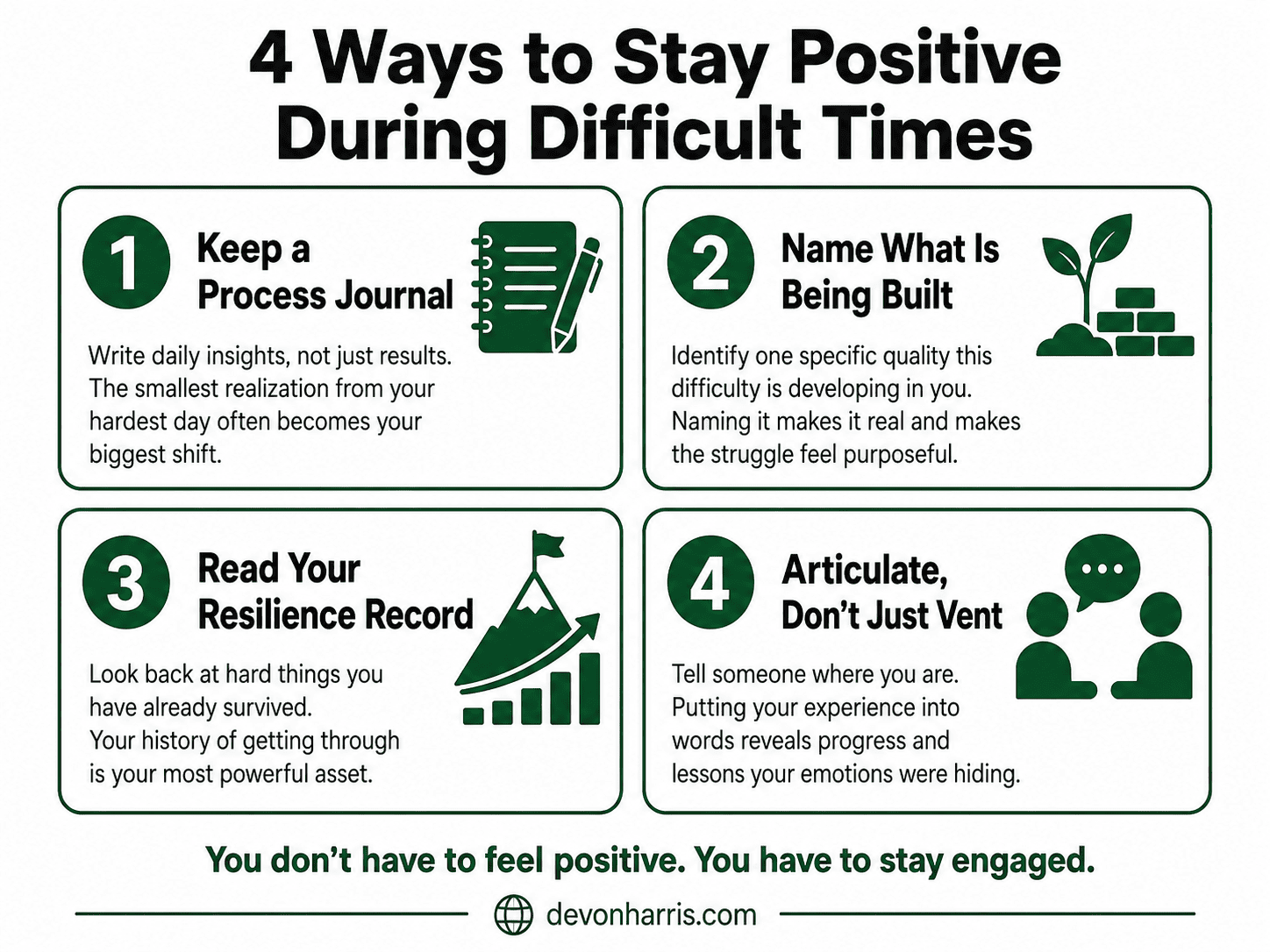
These are not abstract principles. They are things that have worked — for me, and for the people I’ve worked with over many years of speaking and coaching. They work not because they make hard things easy but because they make hard things productive.
Keep a process journal, not a results journal. Most people who journal record what they accomplished. Try recording what you noticed — what surprised you, what confused you, what failed and what that failure might be telling you. The smallest insight from the hardest day is often the one that compounds into your most important growth. It doesn’t have to be long. One honest paragraph is worth more than a page of highlights.
Name the one thing being built in you right now. Not a list. One thing. The specific quality or capability that this specific difficulty is developing that you could not have developed without it. Is it patience? Adaptability? The ability to function under uncertainty? The discovery that you are tougher than you thought? Name it. Write it down. When you can name what a struggle is producing, it loses its power to feel like pure waste.
Read your own resilience record. You have been in a version of this before. Maybe not this exact situation — but the experience of not knowing if you would make it through something, and then making it through. Go back there deliberately. What got you through? What did you learn? What are you carrying from that experience into this one? Most people never deliberately consult their own history of survival. It is one of the most underused resources available to any of us.
Tell someone where you are right now — not to vent, but to articulate. There is a difference. Venting is a release. Articulating is a discovery. When you try to put your current experience into words for someone else, you are forced to find language for things that were previously just feelings. That process of translation almost always reveals something: a pattern you hadn’t noticed, a resource you hadn’t considered, or progress that was happening quietly in the background while you were focused on how hard things were.
When we crossed the finish line in Calgary — cameras flashing, the crowd making a sound I still can’t fully describe — it was an extraordinary moment. I will never say otherwise. Everything we had worked toward, everything we had survived, compressed into four minutes and a finish line. I am grateful for it every single day.
But here is what I know now that I couldn’t have told you then: the finish line didn’t define us. The process did. The sleepless nights, the crashes, the tuition payments, the conversations we had as a team when we were tired and uncertain and still not entirely sure we belonged on that ice. That is where the Jamaican Bobsled Team was actually built. The finish line just gave us a place to show what we’d become.
The positive outlook that I’m describing — the one that actually holds up under real pressure — is not the kind that makes you feel good about where you are. It’s the kind that keeps you engaged with what’s in front of you even when where you are is uncomfortable. It’s the kind that sees a crash as a tuition payment rather than a verdict. The kind that asks “what is this teaching me?” instead of “when does this end?”
That outlook doesn’t come naturally. It comes from practice. And the place to practice it is exactly where you are right now — in whatever valley you are currently climbing through, in whatever process is currently demanding more of you than feels fair.
The medal ceremony is where the glory lives. But the transformation — the real, lasting, bone-deep kind — happens in the valley. Start mining it today.
If you want to build the structure that gives your positive mindset a direction to run in, read my guide on the SMART goal setting framework — because a positive outlook without a clear goal is energy without direction. And if you want to see how these same principles play out inside a team, my post on Olympic teamwork lessons and synchronized success goes deep on how trust and shared purpose turn individual resilience into collective momentum.
Keep On Pushing!
The most effective approach is shifting from outcome questions to process questions. Instead of asking “will this work out?” — which has no answer in the middle of difficulty — ask “what is this teaching me right now?” That single shift redirects your attention from a future you cannot control to a present you can actually engage with. Beyond that: name the one specific thing this difficulty is building in you, keep a journal of insights rather than just achievements, and consult your own history of resilience — because you have survived hard things before, and that record matters more than most people realize.
The most durable positive mindset is not built on optimism — it is built on meaning. When you can identify a genuine purpose inside a difficult experience, the difficulty stops feeling like pure obstacle and starts feeling like productive struggle. Practically, this means treating setbacks as information rather than verdicts, reframing failures as tuition payments for things you needed to learn, and measuring your progress by what you are becoming — not just by what you have achieved. A positive mindset maintained only when things are going well is not really a mindset. It is a mood.
Start with the question you are asking yourself about your situation. Negative mindsets are almost always fueled by outcome-focused questions — will this work, will I fail, is it worth it — that have no good answers from inside the difficulty. Swap those for process-focused questions: what can I learn here, what is being built in me, what would I do differently in the next hour rather than the next year? The second step is to reframe what your setbacks mean. They are not verdicts about your worth or your future. They are data points that reveal assumptions worth correcting. Change the meaning you assign to difficulty, and the way you think about it changes with it.
Not because it makes hard times easier — it often doesn’t. Staying positive during difficult times matters because it determines what you take out of the experience. Two people can go through the same hardship and emerge with completely different results depending on how they related to the process while they were inside it. The person who stayed engaged — who looked for lessons, named the growth, kept showing up — comes out the other side with capabilities, resilience, and self-knowledge that the person who white-knuckled their way through does not have. The difficulty was the same. The attention paid to it was different. That attention is the difference.
Devon tailors every keynote to your audience, your theme and the challenge in front of them.
Learn how to adapt to change with Olympic athlete Devon Harris. Discover 3 core capabilities that build resilience and adaptability .
Learn how to focus on the solution not the problem with Devon Harris. The Olympic mindset shift that turns every obstacle into an opportunity.
Embrace imperfection to unlock authentic growth. Learn how flaws, not perfection, build legacy, connection, and courage.