

Olympic Teamwork Lessons: 3 Secrets to Synchronized Success in Any Team
I have experienced firsthand what it means to succeed as a team against every imaginable odd. As a member of the Jamaican Bobsled Team that competed in the 1988 Calgary Winter Olympics, I learned that athletic glory is never the product of one person’s brilliance. It is built on something deeper — the ability of a group of individuals to synchronize their efforts, trust each other completely, and pursue a shared goal with unwavering commitment.
Our bobsled team had no snow, no track, and almost no funding. What we had was each other. We had a shared vision, relentless communication, and a trust so strong that at 90 miles per hour in a steel sled, none of us doubted the person beside us for a single second. That trust did not happen by accident. It was built deliberately, practiced daily, and protected fiercely.
The Winter Olympics are a masterclass in what human beings can accomplish when they work in true synchronization. Watching a bobsled team navigate a treacherous track with precision, or a figure skating duo move as one across the ice, you are seeing the result of thousands of hours of intentional teamwork. And here is what most people miss: the principles behind those performances are not exclusive to sport. They are the same principles that drive excellence in every boardroom, every project team, and every organization striving for something greater than the status quo.
Here are the three Olympic teamwork lessons that transformed our bobsled team — and can transform yours.
What Olympic Athletes Teach Us About Teamwork
The most important lesson Olympic athletes teach us about teamwork is this: individual talent is the entry fee, not the winning ticket. Every athlete at the Olympics is exceptional. Every team at the Olympics is made up of exceptional individuals. What separates the teams that win gold from those who go home empty-handed is almost never the talent gap — it is the synchronization gap.
Synchronized teamwork means every person on the team knows the goal, knows their role, trusts their teammates, and communicates without hesitation. When those four things are present, a team becomes something greater than the sum of its parts. When even one is missing, the whole machine breaks down — no matter how talented the individuals involved.
In our bobsled team, we were not the most physically gifted athletes at the Calgary Olympics. We were, however, one of the most synchronized. We had a clarity of purpose, a standard of communication, and a level of trust that allowed four Jamaicans who had never seen snow as children to compete on the world’s biggest winter stage. That is what synchronized teamwork does — it closes the talent gap and opens the door to the extraordinary.
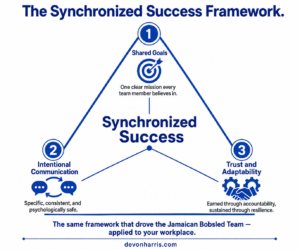
Secret 1: Shared Goals — The Foundation of Synchronized Team Success
Every Olympic team starts from the same place: one clear, unifying objective. For us, it was representing Jamaica on the world stage and proving that where you come from does not determine how far you can go. That shared goal was not just a mission statement — it was a daily compass. Every decision, every sacrifice, every early morning training session was filtered through that single question: does this move us closer to our goal?
Shared goals create alignment. When every member of a team understands not just what they are working toward but why it matters, individual effort transforms into collective momentum. People stop protecting their lane and start supporting the person beside them. They stop competing internally and start competing externally — against the real opposition.
Without a shared goal, even talented teams fragment. Different people pull in different directions, priorities conflict, and the team spends more energy on internal friction than on forward motion. A team without a shared goal is not a team — it is a group of individuals who happen to share an office.
How to apply shared goals in your workplace
- Define the mission in one sentence. If your team cannot state the shared goal in a single clear sentence, it is not clear enough. Clarity is the first step toward alignment.
- Connect every role to the bigger picture. Each team member should understand specifically how their individual contribution moves the team toward the shared goal. When people see the connection between their daily work and the larger mission, engagement rises dramatically.
- Revisit the goal regularly. Olympic teams review their goal before every training session and every competition. Make the shared goal a standing agenda item in team meetings — not as a formality, but as a genuine check-in on alignment.
- Celebrate progress collectively. Wins belong to the team. When one person succeeds, the whole team succeeded in supporting that person. Celebrate together and the goal becomes a source of unity rather than pressure.
Secret 2: Team Communication Strategies That Drive Olympic-Level Results
On the bobsled track, communication is not optional — it is a matter of survival. At 90 miles per hour through a series of banked turns, every cue, every signal, and every adjustment has to be precise, immediate, and trusted. There is no time for ambiguity. There is no room for misunderstanding. The team that communicates cleanly goes fast and stays safe. The team that does not communicates in crashes.
Olympic teams thrive on intentional communication — communication that is proactive rather than reactive, specific rather than vague, and built on a foundation of psychological safety. A figure skating duo does not wait until something goes wrong to communicate. They are constantly reading each other, signaling, adjusting, and confirming. That seamless communication is the product of deliberate practice, not natural chemistry.
Most workplace communication failures are not failures of intelligence or goodwill. They are failures of system. People do not communicate well because they have no established structure for doing so — no regular rhythms, no shared language, no environment where honest feedback is genuinely welcomed. The result is a team where important information gets siloed, misunderstandings multiply, and trust gradually erodes.
Team communication strategies to implement in your organization
- Create communication rhythms. Olympic teams train together daily — their communication is consistent and predictable. Establish regular check-ins, stand-ups, or syncs where information flows as a matter of routine rather than exception. Consistency breeds clarity.
- Build psychological safety. Team members must feel genuinely safe raising concerns, admitting mistakes, and offering ideas without fear of judgment. In our bobsled team, if someone spotted something wrong, they said it immediately — no hesitation, no politics. That same fearlessness needs to exist in your team.
- Be specific, not general. Vague communication is the enemy of synchronized teamwork. Instead of “let’s improve our process,” say “let’s cut response time on client requests from 48 hours to 24 hours by the end of next month.” Specificity creates action. Generality creates confusion.
- Listen as a team skill. Communication is not just about speaking — it is about hearing. In your team, model active listening at every level, especially in leadership. When people feel genuinely heard, they communicate more openly and honestly.
- Use systems and tools intentionally. Whether it is a project management platform, a weekly team brief, or a shared dashboard, put systems in place that keep everyone informed without requiring constant meetings. Information should flow automatically, not only when someone thinks to share it.
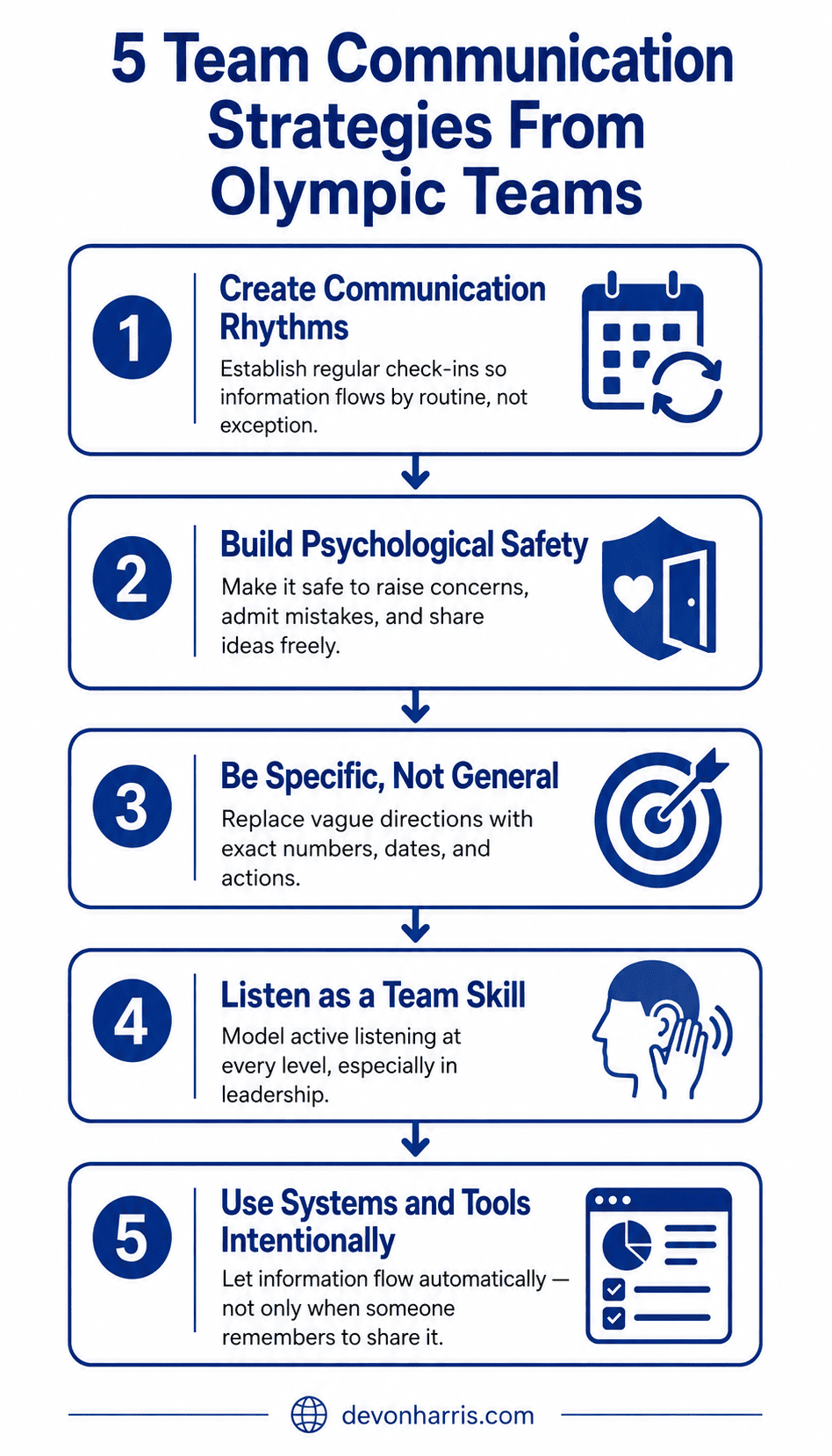
Secret 3: Building Trust and Adaptability in High-Performing Teams
Trust is the invisible infrastructure of every great team. You cannot see it, but when it is missing, everything collapses. In a bobsled at full speed, trust is not a nice-to-have — it is the only reason we could function at all. Each person in that sled had to trust completely that the others would execute their role with precision. The moment any one of us hesitated, doubted, or held back, the entire run was compromised.
Trust in teams is built through three consistent behaviors: keeping commitments, operating with transparency, and showing up for each other when things get hard. It cannot be mandated from the top or installed through a single team-building exercise. It is earned incrementally through hundreds of small moments where people choose accountability over excuse, honesty over comfort, and the team over themselves.
But trust alone is not enough. Olympic athletes know that no matter how well-prepared they are, the unexpected will happen. Conditions change. Equipment fails. The teams that win are not the ones who never face adversity — they are the ones who adapt to it faster than everyone else. Trust gives a team the stability to adapt without fragmenting. When people trust each other, a sudden change in plan is a challenge to solve together rather than a crisis that tears the team apart.
How to build trust and adaptability in your team
- Model accountability at the top. Trust flows downward from leadership. When leaders own their mistakes openly, admit when they do not know something, and follow through on every commitment, it gives the entire team permission to do the same. Accountability is the fastest trust-builder there is.
- Support each other through setbacks. In Calgary, when we crashed in our fourth run, the team did not fracture — we walked to the finish line together, and the crowd rose to their feet. In your organization, the way the team responds to failure either builds trust or destroys it. Choose to support.
- Cultivate a growth mindset. Adaptability starts with the belief that challenges are opportunities to learn rather than evidence of failure. Reward creative problem-solving and experimentation. Make the question after every setback “what did we learn?” rather than “whose fault was it?”
- Practice scenario thinking. Olympic teams mentally rehearse challenges before they happen. Run regular “what if” exercises with your team — what would we do if this went wrong, if that changed, if we lost this resource? Teams that think through adversity in advance adapt to it with far less disruption when it actually arrives.
How to Improve Teamwork in the Workplace Using These Olympic Lessons
Synchronized success does not happen by accident in sport, and it does not happen by accident in business. It is the deliberate result of teams that commit to a shared goal, communicate with intention, and build trust that holds under pressure.
The good news is that you do not need Olympic talent to build an Olympic-level team. What you need is a commitment to the same principles that drive champions: clarity of purpose, consistency of communication, and a culture where every person feels trusted and trusts in return.
Ask yourself and your team these three questions today:
- Can every person on this team state our shared goal in one clear sentence?
- Do our communication systems ensure that the right information reaches the right people at the right time?
- Does every team member feel genuinely trusted — and do they trust the people around them?
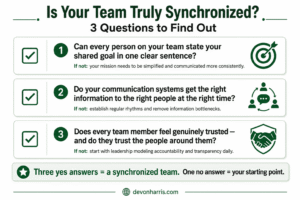
If the answer to any of those questions is “not yet,” you have your starting point. Build from there. The same principles that carried a group of Jamaicans down an icy track in Calgary can carry your team to whatever summit you are aiming for.
For more on building the mindset that drives team success, read my posts on Building Unshakable Team Trust and The Relay Mindset: A Formula for Success. For research-backed insights on high-performing teams, visit Psychology Today.
Keep On Pushing!
Frequently Asked Questions
What do Olympic athletes teach us about teamwork?
Olympic athletes demonstrate that synchronized teamwork — where every member shares a clear goal, communicates with precision, and trusts each other completely — is what separates good teams from great ones. Individual talent matters, but it is the ability to align collective effort toward a single outcome that produces championship results. As a member of the Jamaican Bobsled Team, I experienced this directly: we were not the most gifted athletes in Calgary, but our trust, communication, and shared purpose allowed us to compete on the world stage and inspire millions.
What are the keys to successful teamwork?
The three keys to successful teamwork are shared goals, intentional communication, and mutual trust. Shared goals align individual effort toward a common outcome. Intentional communication ensures everyone stays informed, heard, and connected. Mutual trust gives a team the psychological safety to take risks, admit mistakes, and adapt to adversity without falling apart. When all three are present, teams become capable of achieving things that no individual could accomplish alone.
How do you build trust and communication in a team?
Trust is built through consistent accountability — keeping commitments, acknowledging mistakes openly, and showing up for teammates when things get hard. Communication improves when teams establish regular rhythms, create psychological safety where honest feedback is welcomed, and develop the habit of being specific rather than vague. The most effective way to build both simultaneously is for leadership to model them consistently — teams mirror the behaviors they see at the top.
How do Olympic teamwork lessons apply to the workplace?
Every Olympic teamwork principle translates directly to the workplace. The shared goal that unites an Olympic squad is equivalent to a clear organizational mission every team member believes in. The communication that keeps a bobsled on track is equivalent to the systems and check-ins that keep a workplace team aligned. The deep trust that allows athletes to perform under pressure is equivalent to the psychological safety and accountability culture that allows employees to innovate and recover from setbacks. The environment is different — the principles are identical.