
Jamaica Geography: Location, Size & Island Facts
Jamaica is the third-largest island in the Greater Antilles, rising dramatically from the heart of the Caribbean Sea — 4,411 square miles of mountains, rivers, and coastal plains that shaped one of the world’s most resilient cultures.
Jamaica at a Glance
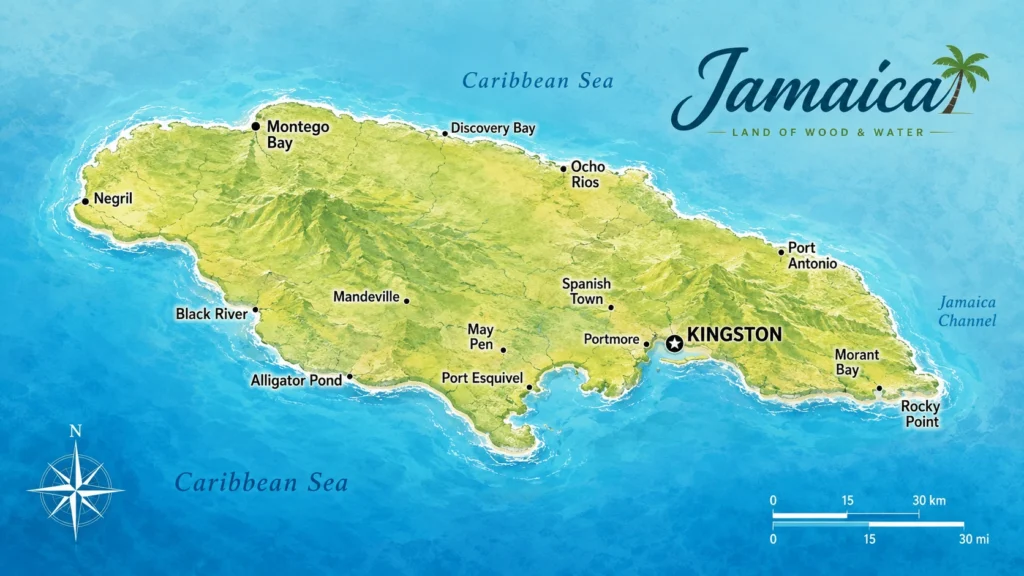
At the Heart of the Caribbean Sea
Jamaica sits near the center of the Caribbean Sea at approximately 18 degrees north latitude and 78 degrees west longitude. Strategically, it is positioned 90 miles south of Cuba and about 100 miles west of Haiti, placing it at the crossroads of major Caribbean sea routes.
Additionally, Cartagena, Colombia — the nearest point on the South American mainland — lies roughly 445 miles almost due south, while Miami, Florida is approximately 571 miles from the capital city of Kingston. This central location has made Jamaica a vital hub for trade, culture, and travel throughout the Caribbean’s history.
Jamaica is the largest English-speaking island in the Caribbean — slightly smaller than Connecticut but packed with extraordinary geographic diversity.
Compact but Extraordinarily Diverse
With a total area of 4,411 square miles, Jamaica is the largest English-speaking island in the Caribbean and, for comparison, is slightly smaller than the U.S. state of Connecticut. The island stretches 146 miles from its eastern to western tip, while its greatest width measures 51 miles — from St. Ann’s Bay in the north to Portland Point in the south.
Despite its relatively compact size, Jamaica’s varied terrain means that travelling from one side to the other can feel like crossing multiple different worlds — from arid southern plains to lush rainforest valleys in the interior.
Tropical Warmth with Dramatic Variation
Jamaica enjoys a tropical maritime climate, which means warm temperatures year-round with refreshing sea breezes along the coast. The island’s average temperature hovers around 82°F (28°C), though interior mountain areas are noticeably cooler.
Rainfall varies significantly by region — the northeastern slopes of the Blue Mountains receive more than 100 inches of rain per year, making them among the wettest areas in the entire Caribbean, while the south and southwestern plains are considerably drier. Jamaica’s hurricane season runs from June through November, a factor that has historically shaped both its landscape and the resilience of its people.
From Sea Level to the Caribbean’s Highest Peak
Jamaica’s landscape ranges dramatically from sea level at the coastline to the towering Blue Mountain Peak at 7,402 feet (2,256 metres) — the highest point in the entire Caribbean. The Blue Mountains, in the island’s eastern interior, rise steeply from the coastal plain over just 10 miles — one of the most abrupt elevation changes in the region.
Jamaica has approximately 120 rivers flowing outward from its central mountains. The Black River — Jamaica’s longest navigable waterway — flows through the Great Morass, the largest freshwater wetland habitat in the Caribbean. The range is also world-famous for producing Blue Mountain Coffee, widely regarded as one of the finest coffees on the planet.
3 Counties · 14 Parishes
Jamaica is divided into three historic counties, further subdivided into 14 parishes. This structure dates back to the British colonial era and remains the foundation of Jamaica’s local government today. Each parish has its own distinct character and administration.

The Island That Shaped Everything I’ve Become
I grew up in Kingston, Jamaica — a city surrounded by the Blue Mountains to the north and the Caribbean Sea to the south. As a child, I didn’t think much about the geography I was reading in school textbooks; I was simply living it.
“It wasn’t until I stood on a bobsled start line in Calgary, Canada — half a world away — that I truly understood what Jamaica had given me: an unshakeable sense of who I was and where I came from.”
That island, small as it is on a world map, produces an outsized spirit. The same resilience that Jamaicans have drawn from their mountains, rivers, and coastlines is the same resilience that powered four men from the tropics to compete at a Winter Olympic Games.
Jamaica Geography — Common Questions
Where is Jamaica located?
Jamaica is located in the Caribbean Sea, approximately 90 miles south of Cuba and 100 miles west of Haiti. It sits at 18 degrees north latitude and 78 degrees west longitude, placing it near the geographic center of the Caribbean island chain. The closest North American city is Miami, Florida, which lies about 571 miles to the northwest.
How big is Jamaica?
Jamaica covers a total area of 4,411 square miles (approximately 10,992 square kilometres), making it the third-largest island in the Greater Antilles and the largest English-speaking island in the Caribbean. The island is 146 miles long from east to west and up to 51 miles wide at its broadest point.
What is Jamaica's highest mountain?
Jamaica’s highest point is Blue Mountain Peak in the Blue Mountains range, which rises to 7,402 feet (2,256 metres) above sea level. It is the highest peak in the entire Caribbean island chain and is part of a mountain range famous worldwide for producing Blue Mountain Coffee. The Blue Mountains are located in the eastern interior of the island.
What is the capital of Jamaica?
The capital of Jamaica is Kingston, located on the southeastern coast of the island. Kingston is Jamaica’s largest city and serves as the country’s economic, cultural, and political centre. It is home to one of the world’s seven largest natural harbours. Spanish Town served as the colonial capital before Kingston took over that role in 1872.
How many parishes does Jamaica have?
Jamaica is divided into 14 parishes, grouped under three historic counties: Cornwall in the west, Middlesex in the centre, and Surrey in the east. The 14 parishes are Kingston, St. Andrew, St. Thomas, Portland, St. Mary, St. Ann, Trelawny, St. James, Hanover, Westmoreland, St. Elizabeth, Manchester, Clarendon, and St. Catherine.
What is the climate like in Jamaica?
Jamaica has a tropical maritime climate with warm temperatures throughout the year, averaging around 82°F (28°C) at sea level. Coastal areas tend to be hotter and more humid, while the interior mountain regions are noticeably cooler. Rainfall varies significantly — the northeastern slopes receive over 100 inches annually, while the southern plains are much drier. Hurricane season runs from June to November.
What is Jamaica's longest river?
Jamaica has approximately 120 rivers flowing from its central mountains to the coast. The Black River in St. Elizabeth Parish is the longest navigable river on the island and flows through the Great Morass — the largest freshwater wetland in the Caribbean. The Rio Minho, flowing south through central Jamaica, is considered the longest river by total distance.
What are Jamaica's chief towns?
Jamaica’s chief towns include the capital city Kingston, Montego Bay (the second-largest city and major tourism hub), Ocho Rios, Negril, Port Antonio, Spanish Town, Mandeville, Black River, Discovery Bay, and Morant Bay. Most of these towns developed along the coastal plains, which offered flatter terrain well-suited to settlement and commerce.