

What if the thing standing in your way was actually pointing you toward something better? Most people look at a challenge and see a stop sign. However, the most successful people in the world — athletes, leaders, entrepreneurs — look at the same challenge and see a different question: “How do I change my mindset about this?” Learning how to change your mindset when facing adversity is not a talent you’re born with. It is a skill. And it is the single most powerful thing you can do to transform your results, your relationships, and your life.
I know this firsthand. When the world heard that Jamaica was sending a bobsled team to the 1988 Winter Olympics, they laughed. No snow. No ice. No chance. However, what most people saw as a joke, we saw as a spark — an opportunity hiding inside an obstacle. That shift in perspective didn’t just get us to the Olympics. It changed everything about how I see every challenge that has come since.
How to Change Your Mindset: The Science Behind Reframing
Before we talk about how to change your mindset, it helps to understand why the mind gets stuck in the first place. When we face a challenge, our brain’s threat response kicks in automatically. Heart rate rises. Thinking narrows. We see danger before we see possibility. This is completely normal — it is how human beings are wired for survival.
However, here is what makes the difference between those who get stuck and those who move forward: the ability to reframe. Reframing is a science-backed mental strategy that deliberately shifts how you interpret a situation. Furthermore, it doesn’t mean pretending things aren’t hard. Instead, it means choosing a more empowering lens through which to see them.
Research from Stanford University confirms this. People who view stress and adversity as a tool rather than a threat perform significantly better under pressure. Moreover, they build greater resilience over time. Teams trained in reframing techniques solve problems 35% more effectively than those who aren’t. Therefore, learning how to change your mindset through reframing is not just a feel-good idea — it is a measurable performance advantage. If you’ve been struggling with self-doubt alongside your challenges, my post on turning doubt into opportunity is a powerful companion to this one.
What Reframing Is — and What It Isn’t
Many people confuse reframing with toxic positivity — the idea of slapping a smile on a painful situation and pretending everything is fine. However, that is not what we are talking about here. Furthermore, that approach doesn’t work and most people can see right through it.
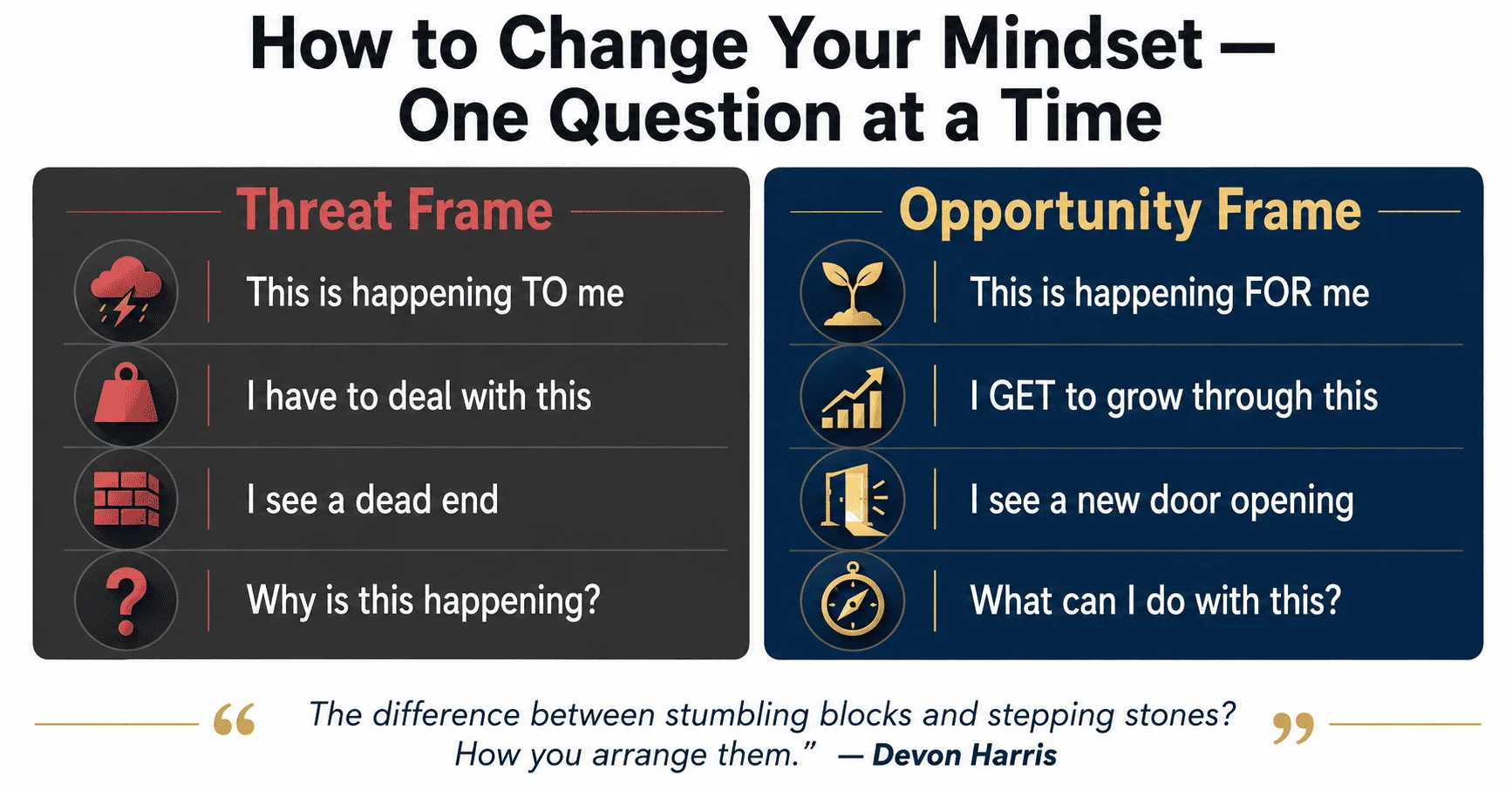
Real reframing is honest. It acknowledges that the challenge is real, that it is hard, and that it hurts. However, it then asks a different question than most people ask. Instead of “Why is this happening to me?” it asks “What can I do with this?” That one shift — from victim to creator — is the foundation of how to change your mindset in any situation.
How to Change Your Mindset in 3 Practical Steps
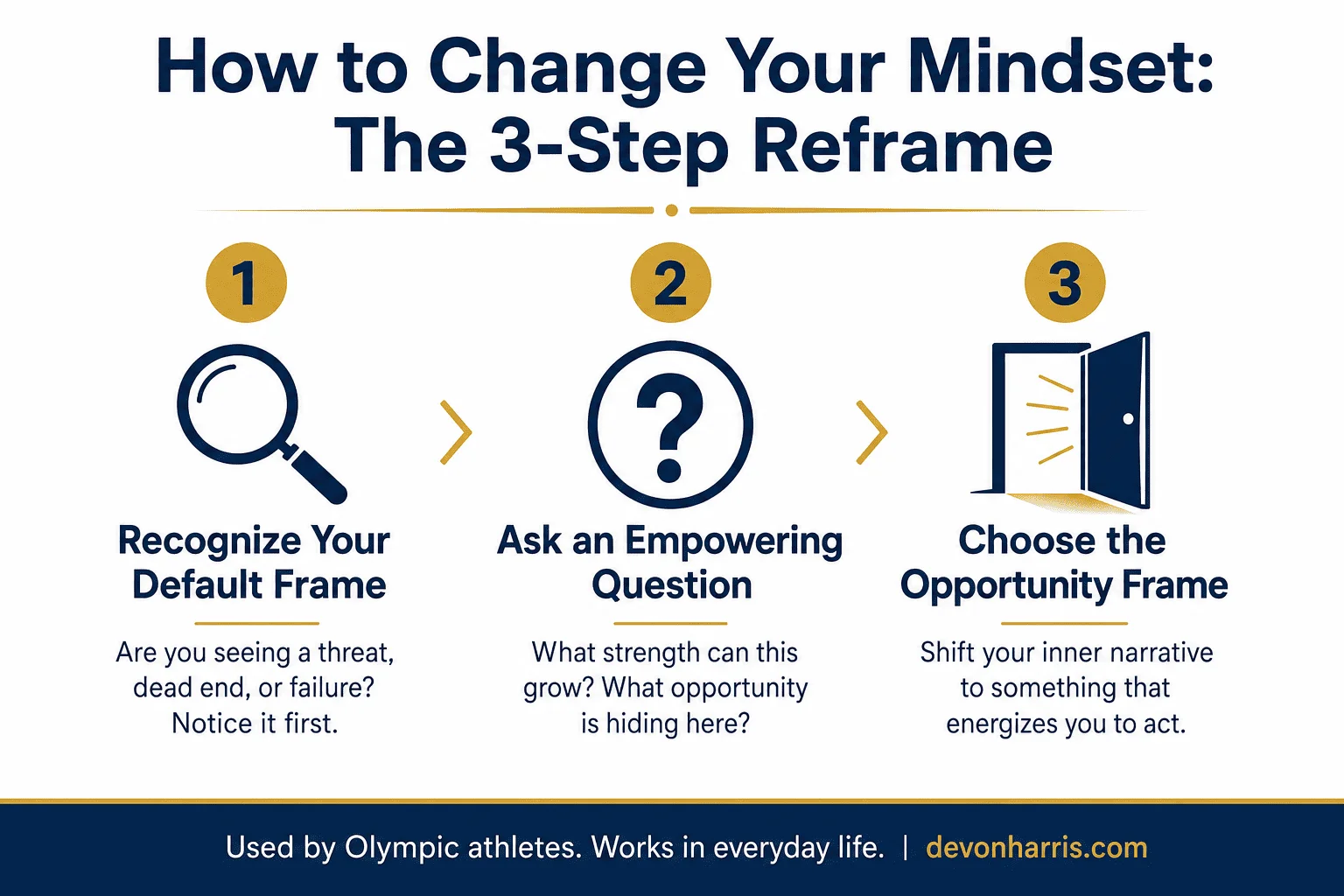
The good news is that reframing is a learnable skill. Furthermore, it gets easier the more you practice it. Here are the three steps I have used personally — on bobsled tracks, in business, and in life — to change my mindset when facing adversity:
Step 1: Recognize Your Default Frame
The first step in how to change your mindset is simply to notice what frame you are currently in. Most people never do this because the default frame feels like reality — it feels like just “the way things are.” However, it isn’t. It is one interpretation among many possible interpretations.
Ask yourself: Am I seeing this situation as a threat, a dead end, or a failure? If yes, that is your default frame speaking. Moreover, just noticing it is already powerful — because you cannot change something you cannot see. Therefore, awareness is always the first move.
Step 2: Ask an Empowering Question
Once you recognize your default frame, the next step is to interrupt it with a better question. Empowering questions redirect your brain’s attention from what is wrong to what is possible. Here are some that work consistently:
- “What strength can I build through this experience?”
- “What opportunity might be hiding inside this obstacle?”
- “What would I do right now if I weren’t afraid?”
- “What is this situation trying to teach me?”
These questions don’t make the challenge disappear. However, they shift your mental energy from analysis of the problem to generation of solutions. Furthermore, that shift is where momentum begins. As a result, your brain starts looking for answers instead of confirming the problem.
Step 3: Choose the Opportunity Frame
The final step is to deliberately choose a new frame — one that is honest about the difficulty but focuses your energy on what you can actually do. This is how you change your mindset from reactive to proactive, from passive to powerful.
During our Olympic journey, we faced this choice constantly. No training facility access? We reframed it as an opportunity to innovate. Media mockery? We reframed it as free publicity. A crash on the track? We reframed it as proof of our unshakable determination. Therefore, every block became a building stone — because we chose to see it that way.
Building a Resilient Mindset: How to Overcome Adversity Long-Term
Knowing how to change your mindset in a single moment is valuable. However, the real power comes from building a resilient mindset over time — one that responds to adversity as a matter of habit, not just conscious effort. Furthermore, this is what separates people who bounce back quickly from those who stay stuck for months or years.
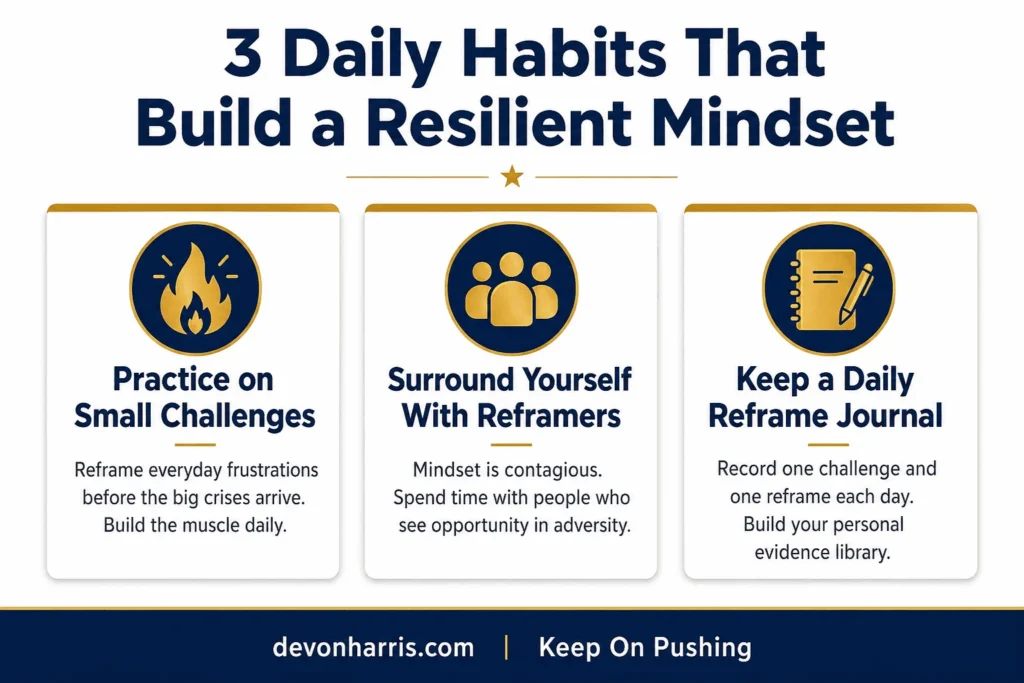
A resilient mindset is not built in one big dramatic moment. Instead, it is built through small, repeated choices to reframe — every day, in small situations, long before the big crisis arrives. Think of it like a muscle. The more you use it, the stronger it gets. Therefore, here is how to build that muscle deliberately:
Practice on Small Challenges First
Don’t wait for a major life crisis to practice reframing. Instead, start with the small frustrations of everyday life. Stuck in traffic? Reframe it as quiet time to think. A meeting ran over? Reframe it as an opportunity to practice patience. A plan fell through? Reframe it as space for something better to emerge.
These small daily reframes build the neural pathways that make how to change your mindset instinctive when the big challenges arrive. Furthermore, they train your brain to search for the opportunity angle automatically, rather than defaulting to the threat response. As a result, you become someone who genuinely sees possibility where others see only problems — and that is a profound competitive advantage in every area of life.
Surround Yourself With Reframers
One of the most powerful ways to build a resilient mindset is to spend time with people who already have one. Moreover, mindset is contagious — both the limiting kind and the empowering kind. When you are around people who consistently reframe challenges as opportunities, you absorb that habit without even trying.
During our Olympic preparation, being part of a team that refused to see our obstacles as reasons to quit was transformative. Furthermore, on the days when my own resolve wavered, the team’s collective mindset carried me. Therefore, be intentional about who you spend your time with — because your environment shapes your thinking more than most people realize. This connects directly to what I explore in my post on embracing change as growth — because resilience and adaptability are built together.
Review Your Reframes Regularly
Keep a simple journal — even just three lines at the end of each day — where you record one challenge you faced and how you reframed it. Furthermore, over time, this practice creates a personal library of evidence that reframing works for you specifically. As a result, when a new challenge arrives, you don’t just believe that reframing is possible — you have proof that you have done it before.
From the Ice Track to Your Life: Real Examples of Mindset Change
Let me bring this to life with something concrete. Here is how the reframing approach played out in real situations during our Olympic journey — and how the same principle applies directly to challenges you might be facing right now:
The obstacle: Established bobsled teams refused to share training space with us.
The default frame: We are being excluded. We don’t belong here.
The reframe: We get to figure out our own way. This is making us more creative and self-reliant than any team here.
The obstacle: The world media laughed at the idea of a Jamaican bobsled team.
The default frame: We are being humiliated. Nobody believes in us.
The reframe: Every article written about us is free publicity. The story is too good for people to ignore. Furthermore, we are going to make them eat those words.
The obstacle: We crashed on the track during the Olympics.
The default frame: We failed on the world’s biggest stage. This is the end of the story.
The reframe: We showed the world that we had the courage to get on that track at all. Moreover, the way we walked away with dignity made us more famous than if we had simply finished the race.
The same reframing process applies to your challenges. A job loss becomes an invitation to find work that actually fits you. A relationship ending becomes space for something healthier. A business failure becomes the most expensive education you will ever receive — and also the most valuable. Therefore, how to change your mindset about any situation always starts with this question: “What if this is happening for me, not to me?”
Your Challenge Starts Now
Think of one challenge you are currently facing. It doesn’t matter how big or small it is. Now ask yourself these three questions:
- What strength can this grow in me?
- What possibility might this unlock that wasn’t available before?
- What new door might open because of this obstacle?
Your obstacle might just be your origin story. Furthermore, the difference between stumbling blocks and stepping stones is simply how you arrange them. Therefore, your challenges aren’t going away — but your relationship with them can evolve starting right now.
How to change your mindset is not a one-time decision. It is a daily practice, a lifelong discipline, and ultimately one of the greatest gifts you can give yourself. Moreover, every time you choose the opportunity frame over the threat frame, you become a little more of the person you were meant to be.
Keep On Pushing!
Frequently Asked Questions
How do you change your mindset when facing challenges?
Changing your mindset when facing challenges starts with recognizing the frame you are currently in — are you seeing the situation as a threat or an opportunity? From there, interrupt that default frame with an empowering question such as “What can I learn from this?” or “What opportunity is hiding here?” Furthermore, deliberately choose a new interpretation that focuses your energy on what you can actually do rather than what you cannot control. This three-step process — recognize, question, reframe — is how to change your mindset in any situation, regardless of how difficult it feels.
What is the difference between reframing and toxic positivity?
Reframing is honest — it fully acknowledges that a challenge is real and difficult, then asks what can be done with it. Toxic positivity, however, denies or minimizes the difficulty entirely and simply insists on feeling good about it. Furthermore, reframing is a practical mental strategy backed by psychology research, while toxic positivity is a way of avoiding genuine emotional processing. Therefore, true reframing makes you more effective in the face of adversity, while toxic positivity often makes challenges worse by suppressing them.
How do you build a resilient mindset?
A resilient mindset is built through small, consistent daily choices to reframe rather than one dramatic act of willpower. Start by practicing on small frustrations — reframe everyday inconveniences before the big challenges arrive. Furthermore, surround yourself with people who already demonstrate resilient thinking, because mindset is contagious. Keep a daily journal where you record one challenge and one reframe. As a result, over weeks and months, your brain begins to search for opportunity angles automatically, making resilience a habit rather than an effort.
How to overcome adversity using mindset shifts?
To overcome adversity using mindset shifts, start by separating the facts of the situation from your interpretation of it. The facts are fixed — your interpretation is always a choice. Furthermore, ask yourself what a person you admire would see in this situation that you might be missing. Then take one small action in the direction of the opportunity rather than continuing to analyze the obstacle. Moreover, remember that every significant success story — including Jamaica’s Olympic bobsled team — involved people who chose to see their obstacles differently than the rest of the world did.
Can anyone learn how to reframe challenges as opportunities?
Absolutely. Reframing is a skill, not a personality trait — which means anyone can develop it with consistent practice. Furthermore, research in neuroplasticity confirms that the brain can form new habitual thought patterns at any age. The key is starting small and being consistent. Therefore, you don’t need to be born optimistic or naturally resilient to become someone who sees opportunity in adversity. You simply need to practice the three steps — recognize your default frame, ask an empowering question, and choose a more useful interpretation — repeatedly, until it becomes instinctive.