
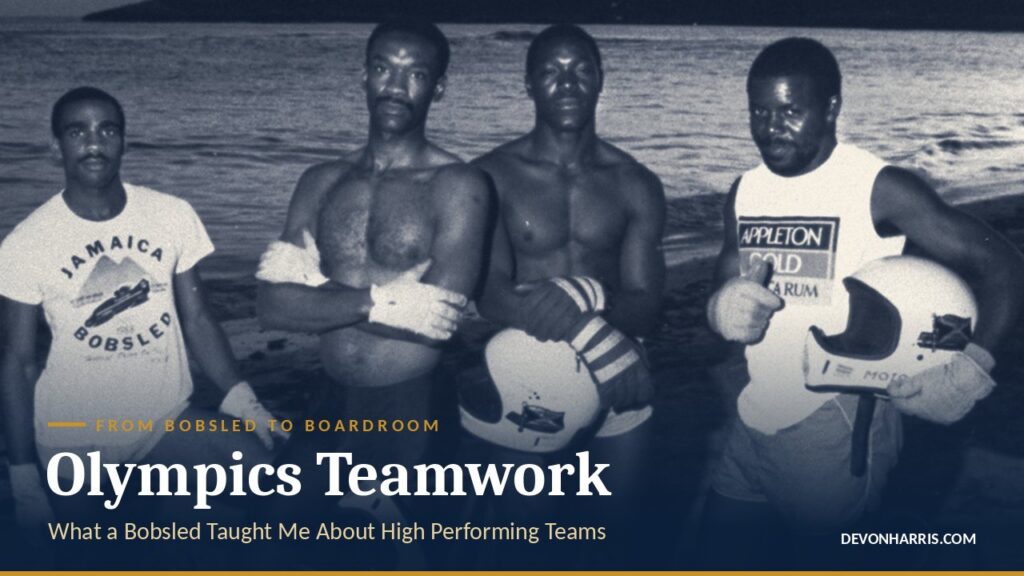
A bobsled start lasts only a few seconds. Four athletes sprint beside a heavy sled, then load in one at a time, in a fixed order, with no time to look at each other. If one man is late, all four pay for it at the bottom of the track. That is olympics teamwork in its purest form, and I learned it as a founding member of the 1988 Jamaican bobsled team.
We came from a country with no ice and no bobsled tradition. What we had was each other, and very little time to learn how to move as one unit. Those lessons followed me from the track into the conference rooms where I now speak to leaders. They are the same lessons that separate high performing teams from groups of talented people who happen to share a building.
What Is Olympics Teamwork?
Olympics teamwork is the practice of individual athletes giving up personal glory for a shared result. It rests on four principles: a shared vision everyone can see, trust that holds under pressure, team resilience that turns setbacks into fuel, and a habit of celebrating progress on the way to the goal. The same four principles drive high performing teams in business.
The Olympic stage makes these principles easy to see. A relay team can have the four fastest runners in the country and still drop the baton. A bobsled crew can have the strongest pushers in the field and still lose the race at the start. Talent gets a team to the Games. Teamwork decides what happens once it is there.
Four Men, One Sled: Teamwork Lessons From the Jamaican Bobsled Team
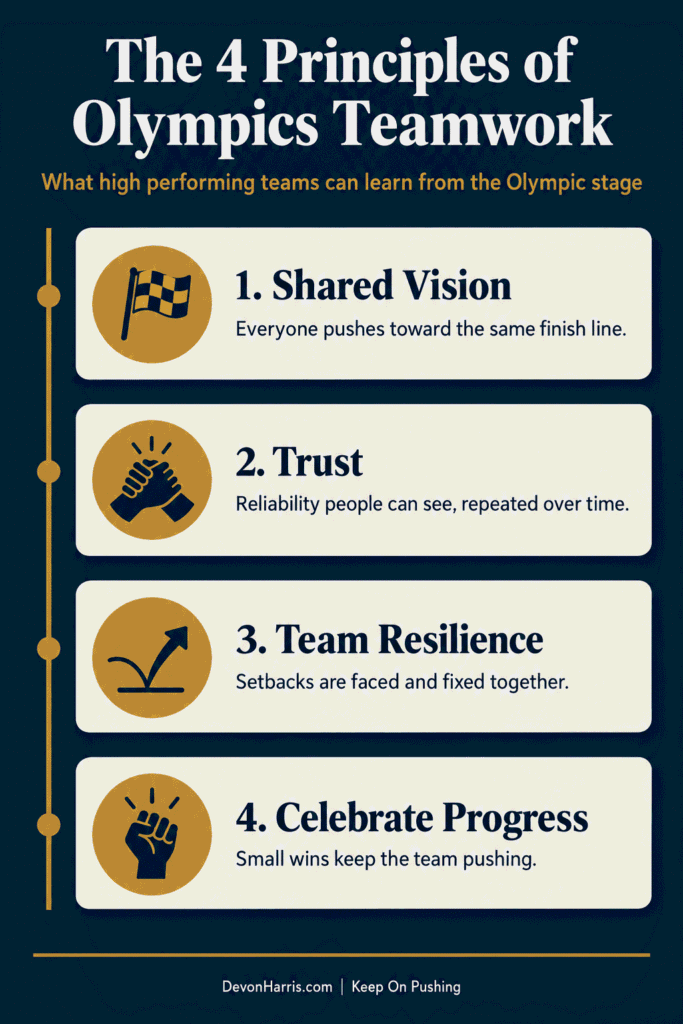
In a four-man bobsled, every seat carries a job that nobody else can do for you. The pilot pushes, loads first and steers. The two middle crewmen drive the sled off the line and load in without breaking its path. The brakeman gives the final push, jumps in last and stops the sled after the finish. Once the sled is moving, each man either does his job or the whole team feels the cost.
That structure made accountability simple. There was no hiding in a bobsled, and there was no room for blame either, because everyone could see exactly where a run was won or lost. When a start went wrong, the question was never who looked good. The question was whether each man delivered his piece of the whole.
Most workplaces blur this. Roles overlap, handoffs are vague, and when a project fails, nobody can say where it slipped. High performing teams borrow the bobsled model. Every person knows their seat, knows the moment they load in, and knows the team result depends on that handoff.
Shared Vision: Every Push Aimed at the Same Finish Line
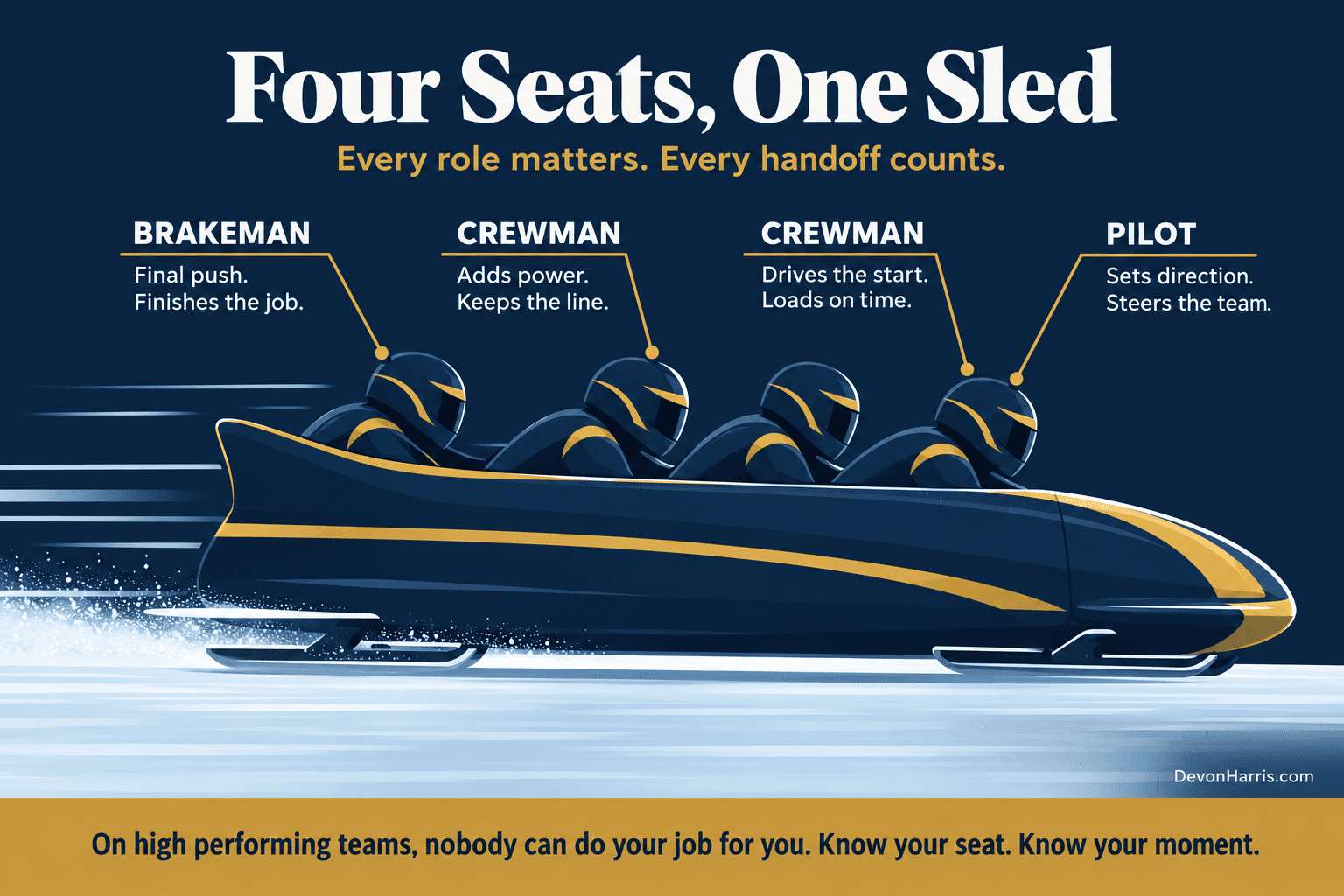
A bobsled only runs straight when four people push in the same direction. Push a little to the side and you steal speed from the athlete next to you. Teams in any organization work the same way. People rarely fail because they are lazy. They fail because they are pushing hard toward slightly different finish lines.
Our finish line in 1988 was clear: get to Calgary and prove that a team from a tropical island belonged on that track. Every hard session pointed at that one picture.
For leaders, a shared vision is more than a mission statement on a wall. Three questions will tell you whether your team has one:
-
- Can every person describe the goal in one sentence, in their own words?
-
- Does each person know how their role moves the team toward it?
-
- When priorities clash, does the goal settle the argument?
If the answer to any of these is no, your team is working hard in several directions at once.
How to Build Trust in a Team When the Stakes Are High
On a bobsled track, trust is not a feeling. It is a decision you make at the start line, when you jump into a sled and place your safety in the hands of the man steering it.
I learned what that trust asks of you during a week of training when I was sick with a fever. More than once I stood at the top of the track shivering one minute and roasting the next. We had to complete those training runs for our team to qualify for that week’s race, so staying home was not an option. I kept my mind on one thing: getting down the track. My teammates were counting on me, and I refused to be the reason they lost their chance.
Trust on high performing teams is built the same way, through reliability that people can see, repeated over time. Here is how to build trust in a team you lead:
-
- Keep small promises. Trust is earned in the ordinary deadline long before it is tested in the crisis.
-
- Make roles and handoffs visible. People trust a system they can see. Say who owns what, and when the baton passes.
-
- Surface mistakes early. A team that hides small errors will hide big ones. Reward the person who raises the problem.
-
- Show up on the hard days. Your team remembers what you did when it was difficult, not what you said when it was easy.
Trust is the base layer of real teamwork and collaboration. Without it, people protect themselves instead of protecting the team.
Team Resilience: What Our Calgary Crash Taught Me
At the 1988 Winter Olympics in Calgary, our sled crashed during the four-man event. We had come a very long way to be on that track, and the run we had worked toward ended in a crash. We climbed out, and together we brought the sled across the finish line.
People still talk to me about that image. What I remember is the decision underneath it. Nobody walked away from the others. Nobody pointed a finger. We finished as a team because the result belonged to all four of us, including the bad one.
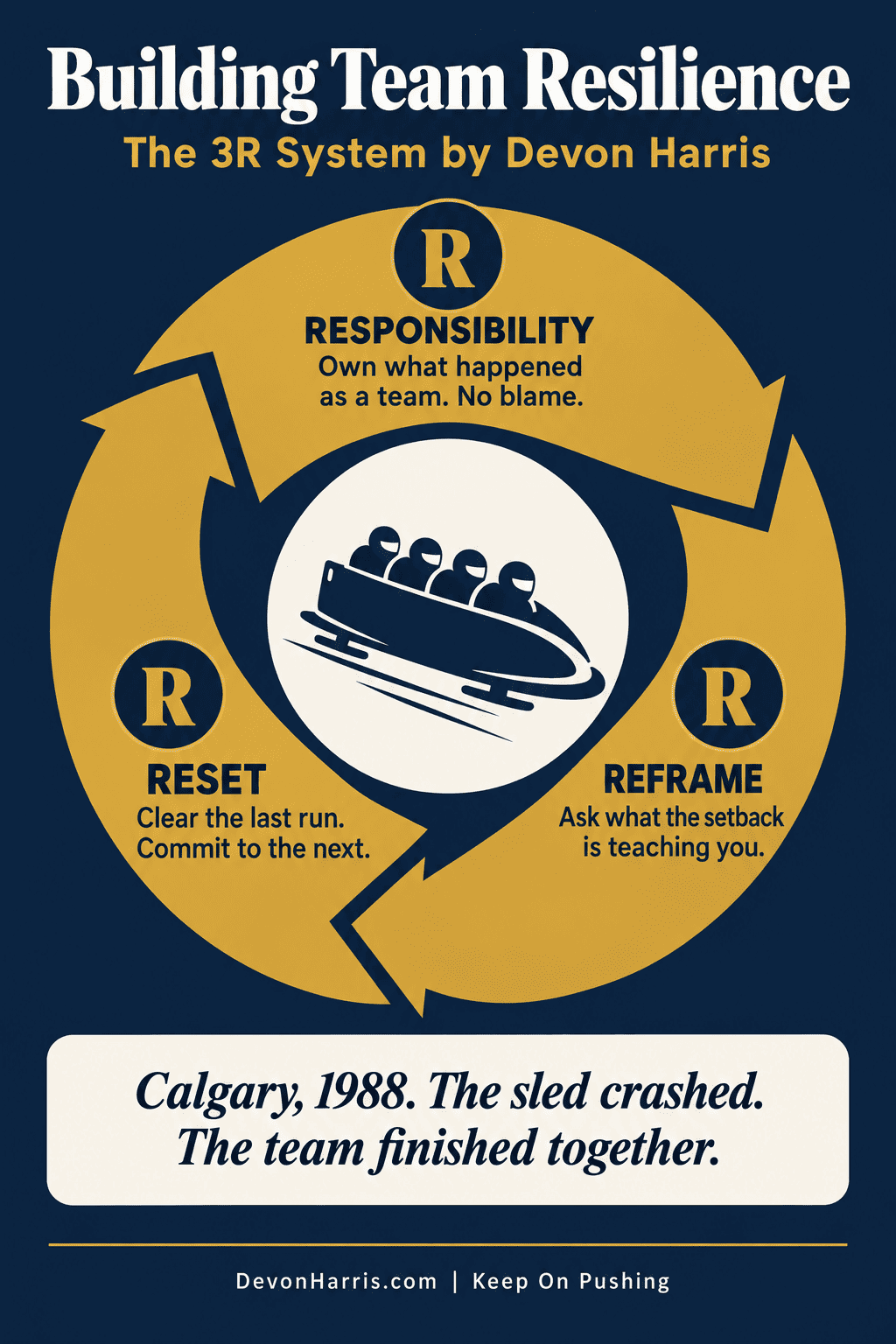
That is team resilience. It is not the absence of setbacks. It is the way a team responds, together, when a setback lands. I teach it through the 3R System:
-
- Responsibility: Own what happened as a team. Skip the search for someone to blame and look at what each person controls.
-
- Reframe: Ask what the setback is teaching you. A crash shows you exactly where the run broke down.
-
- Reset: Clear the last run from your mind and commit fully to the next one.
- Reset: Clear the last run from your mind and commit fully to the next one.
Resilient teams do not wait for a crisis to practice this. They run the 3R System on small misses, such as a lost deal or a delayed launch, so the response is automatic when a big setback arrives.
Adapting Together: Three Start Changes Before Albertville
Between Calgary and the 1992 Games in Albertville, we changed our start sequence three times. Each change meant unlearning a motion we had drilled over and over, and trusting that the new version would be faster before we had proof. Adapting as a team is harder than adapting alone, because everyone has to let go of the old way at the same moment.
The same is true when a company changes a process, a tool or a strategy. Explain why the change matters. Practice it together. Give people room to be slow before they get fast. If your team is in the middle of that kind of shift, these lessons on how to adapt to change will help.
Celebrate Progress, Not Just Podiums
Most Olympians never stand on a podium. The athletes who last are the ones who learn to celebrate a cleaner start, a faster push time or a run without a single mistake. Olympic teamwork is built in the years between Games, one small win at a time.
Recognition works the same way at work. Name the specific thing someone did well, instead of a general “great job.” Celebrate the team result before the individual one. Recognize progress in public and correct in private. People who feel seen will push harder the next time the sled needs moving.
How to Bring Olympics Teamwork Into Your Workplace
You do not need a bobsled to put these lessons to work. Start with these five steps this quarter:
-
- Write the finish line down. One sentence that every team member can repeat without looking.
-
- Assign every seat. Make sure each person knows their role and the exact moment their work hands off to someone else.
-
- Practice the start. Rehearse the handoffs that matter most, such as launches, client onboarding and quarter-end, before the pressure is real.
-
- Run the 3R System after every miss. Responsibility, Reframe, Reset, in that order, as a team.
-
- Celebrate small wins out loud. Progress that gets noticed gets repeated.
Frequently Asked Questions About Olympics Teamwork
What can businesses learn from olympics teamwork?
Businesses can learn that talent alone does not win. Olympic teams succeed through a shared vision, clear roles, trust under pressure and a disciplined response to setbacks. Leaders who build those four habits create high performing teams that hold together when results get hard.
Why is teamwork important in the Olympics?
In team events such as bobsled, relays and rowing, every athlete depends on the others to deliver their part at the right moment. One late push or dropped baton costs the whole team. Teamwork turns individual strength into a single, faster result.
How do you build trust in a team?
You build trust in a team through visible reliability over time. Keep small promises, make roles and handoffs clear, surface mistakes early and show up for your people on the hard days. Trust grows when words and actions match again and again.
What is team resilience?
Team resilience is a group’s ability to absorb a setback and recover together without breaking into blame. Devon Harris teaches it through the 3R System: take Responsibility as a team, Reframe the setback as information, and Reset fully for the next attempt.
What makes high performing teams different?
High performing teams share one clear goal, know exactly who owns each part of the work and trust each other enough to speak up early. They also practice their handoffs and treat setbacks as lessons rather than reasons to point fingers.
The next time your team hits a hard stretch, picture four men climbing out of a crashed sled in Calgary and bringing it across the finish line together. That is the standard. Push together, finish together.
Keep On Pushing!
Bring This Story to Your Team
Three-time Olympian Devon Harris helps leaders build resilient, high performing teams through the story of the Jamaican bobsled team.
Explore Devon’s Resilience Keynote