

At some point in life, everyone faces a moment that threatens to break them. A loss, a failure, a setback so unexpected that it seems impossible to recover. Yet some people do recover. Not only that — they emerge from adversity stronger, wiser, and more capable than before. So what is resilience, exactly? And why do some people seem to have it naturally while others struggle to find it? The answer to both questions will change how you see every challenge you face from this point forward.
Resilience is not a personality trait that only a fortunate few are born with. Furthermore, it is not the absence of pain, fear, or difficulty. Instead, resilience is a dynamic skill — one that anyone can develop, strengthen, and apply in every area of life. Moreover, understanding what resilience means is the first step toward building it deliberately. Therefore, in this guide, we will cover exactly what resilience is, the different types of resilience, real examples from everyday life, and the practical steps you can take to become a more resilient person starting today.
What Is Resilience? The Definition That Changes Everything
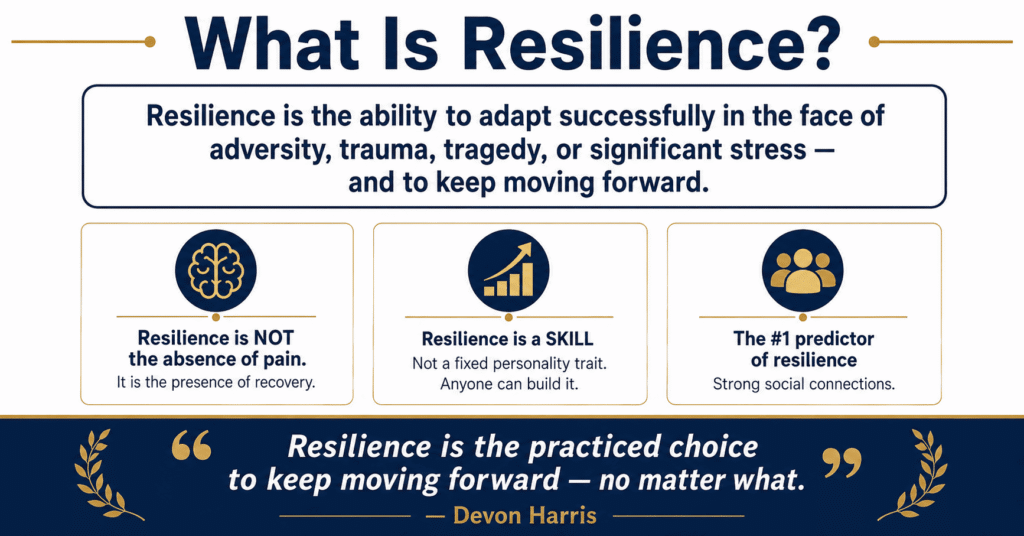
The most widely used definition of resilience comes from psychology: resilience is the ability to adapt successfully in the face of adversity, trauma, tragedy, threats, or significant sources of stress. However, this clinical definition only tells part of the story. Furthermore, understanding what resilience truly means requires going deeper than a dictionary entry.
Resilience is not toughness in the sense of being unaffected by difficulty. Moreover, it is not suppressing emotion or pretending challenges don’t exist. Instead, what resilience really means is the capacity to experience difficulty fully — to feel the weight of it, to be genuinely shaken by it — and still find a way to move forward. Therefore, resilience is not the absence of struggle. It is the presence of recovery.
What Is Emotional Resilience?
Emotional resilience is a specific and particularly powerful dimension of overall resilience. The emotional resilience definition refers to the ability to regulate your emotional responses under pressure — to feel difficult emotions without being controlled or paralyzed by them. Furthermore, emotionally resilient people can process setbacks, disappointments, and losses without losing sight of their ability to act and move forward. Moreover, emotional resilience is not about being stoic or emotionless — it is about having the emotional flexibility to experience the full range of human feeling while maintaining forward momentum.
Research from the American Psychological Association confirms that emotional resilience is one of the strongest predictors of long-term wellbeing, professional success, and relationship quality. Therefore, developing your emotional resilience is not just a personal growth exercise — it is a fundamental life skill with measurable outcomes. This connects to what I explore in my post on building resilience through self-compassion — because emotional resilience and self-compassion are deeply intertwined.
What Is Mental Resilience?
Mental resilience refers specifically to your capacity to maintain clarity of thought, focus, and purposeful action under conditions of high stress, uncertainty, or adversity. Furthermore, mental resilience is what allows you to keep making good decisions when everything around you feels chaotic. Moreover, it is the ability to hold a long-term vision even when short-term circumstances are discouraging. Therefore, mental resilience is the cognitive counterpart to emotional resilience — together, they form the foundation of true psychological strength.
The 4 Types of Resilience You Need to Know
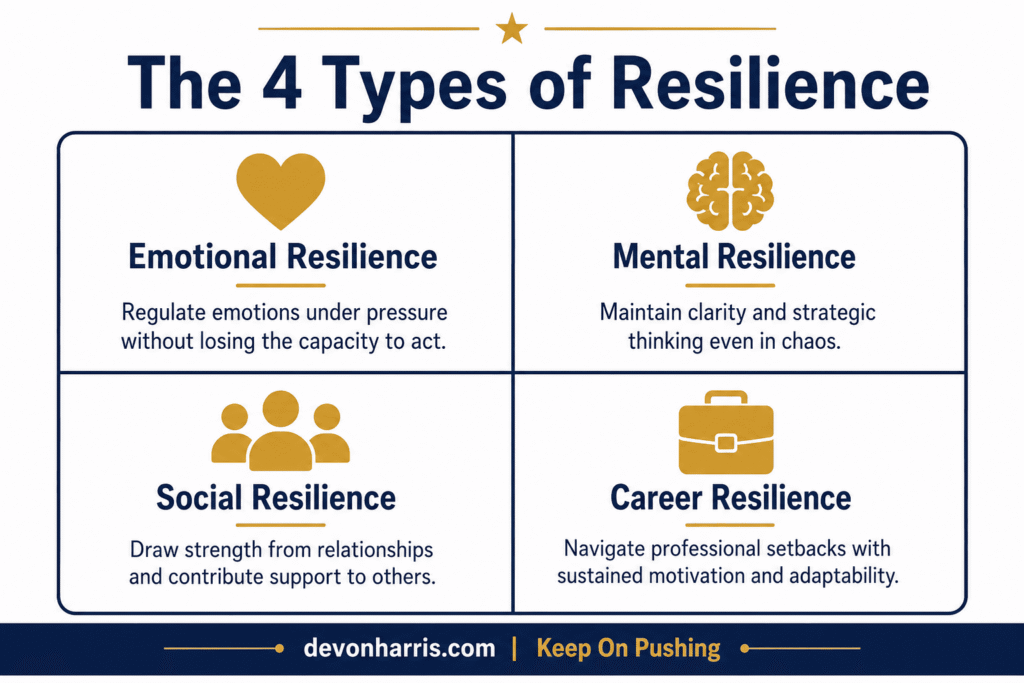
When people ask what is resilience, they are often thinking about it as a single quality. However, resilience is actually a cluster of related capacities that operate across different domains of life. Furthermore, understanding the different types of resilience helps you identify where your strengths already lie and where you have the most room to grow.
1. Emotional Resilience
The ability to process and regulate emotions under pressure without losing the capacity to act. Moreover, emotionally resilient people recover from setbacks faster and build stronger relationships because they can engage with difficulty without becoming overwhelmed by it.
2. Mental Resilience
The capacity to maintain clarity, focus, and strategic thinking under conditions of high stress or uncertainty. Furthermore, mental resilience enables better decision-making when it matters most — in the moments when most people become reactive and impulsive.
3. Social Resilience
The ability to draw on and contribute to supportive relationships and communities during difficult times. Moreover, research consistently shows that social connection is one of the most powerful predictors of resilience — isolated individuals recover from adversity significantly more slowly than those with strong social bonds.
4. Career and Professional Resilience
The ability to navigate professional setbacks — job loss, failure, rejection, organizational change — and continue pursuing meaningful work with sustained motivation and adaptability. Furthermore, career resilience has become one of the most sought-after qualities in the modern workforce, where change and disruption are constants rather than exceptions.
Real Examples of Resilience in Everyday Life
Understanding what resilience means becomes far more concrete when you see examples of resilience in real life. Furthermore, resilience doesn’t only show up in dramatic, headline-making stories — it appears in small, daily acts of recovery that most people never notice but that compound powerfully over time.
Examples of Being Resilient in Real Life
Here are some of the most powerful and relatable examples of resilience that anyone can recognize in their own experience:
- Starting over after job loss. Losing a job is one of the most destabilizing experiences an adult can face. However, resilient individuals use the period of transition to reassess, retrain, and often discover work that is more aligned with their actual strengths and values than the job they lost.
- Rebuilding after a relationship ends. The end of a significant relationship can feel like the end of a chapter of identity, not just a partnership. Moreover, resilient people grieve fully and then deliberately reconstruct a sense of self and purpose that isn’t dependent on the relationship that ended.
- Recovering from health challenges. Physical illness or injury forces a person to confront their own vulnerability in a direct and unavoidable way. Furthermore, examples of resilience in this context include adapting daily life, finding meaning in the recovery process, and maintaining hope without denying the difficulty.
- Persisting through repeated failure. Perhaps the most universal example of being resilient is the willingness to try again after failing — not because failure doesn’t hurt, but because the goal matters more than the comfort of avoiding risk.
The Jamaican Bobsled Team: A Living Example of Resilience
When I helped found the Jamaican bobsled team in 1988, we were told our goal was impossible. No experience. No snow. No funding. No world belief. However, what we did have was the choice of how to respond to those obstacles — and we chose resilience. Furthermore, we adapted our training to what was available. We studied our competitors obsessively. We used every limitation as information rather than as a verdict. Moreover, on February 14, 1988, the Jamaican bobsled team competed at the Winter Olympics — not because everything went perfectly, but because we refused to treat adversity as a permanent condition. Therefore, that journey remains the most vivid example of resilience in everyday life that I have ever witnessed firsthand.
Signs of Resilience: How to Know If You’re More Resilient Than You Think
Many people who are genuinely resilient don’t recognize it in themselves. Furthermore, resilience doesn’t always look dramatic from the inside — it often feels like simply putting one foot in front of the other, even when you’d rather stop. Therefore, here are some of the most consistent signs of resilience that research and lived experience both confirm:
- You recover from setbacks without becoming permanently defined by them
- You can sit with discomfort or uncertainty without immediately trying to escape it
- You ask “What can I do about this?” more often than “Why is this happening to me?”
- You seek support when you need it rather than isolating in silence
- You find meaning or lessons even in painful experiences
- You adapt your approach when a strategy isn’t working, rather than repeating it hoping for different results
- You maintain a sense of possibility about the future even during difficult present circumstances
Furthermore, if several of these signs describe you — even imperfectly, even inconsistently — you are already more resilient than you may realize. Moreover, recognizing your existing resilience is itself a form of strengthening it, because self-awareness is always the first step toward intentional growth. This is why I explore the idea of celebrating small progress in my post on why every effort deserves to be celebrated.
How to Build Resilience: 5 Practical Strategies That Work
Now that we’ve established what resilience is and what it looks like in real life, the most important question becomes: how do you build it? Furthermore, the good news is that resilience is genuinely buildable — the American Psychological Association, Harvard Medical School, and decades of psychology research all confirm that resilience can be deliberately developed at any age, in any circumstance.
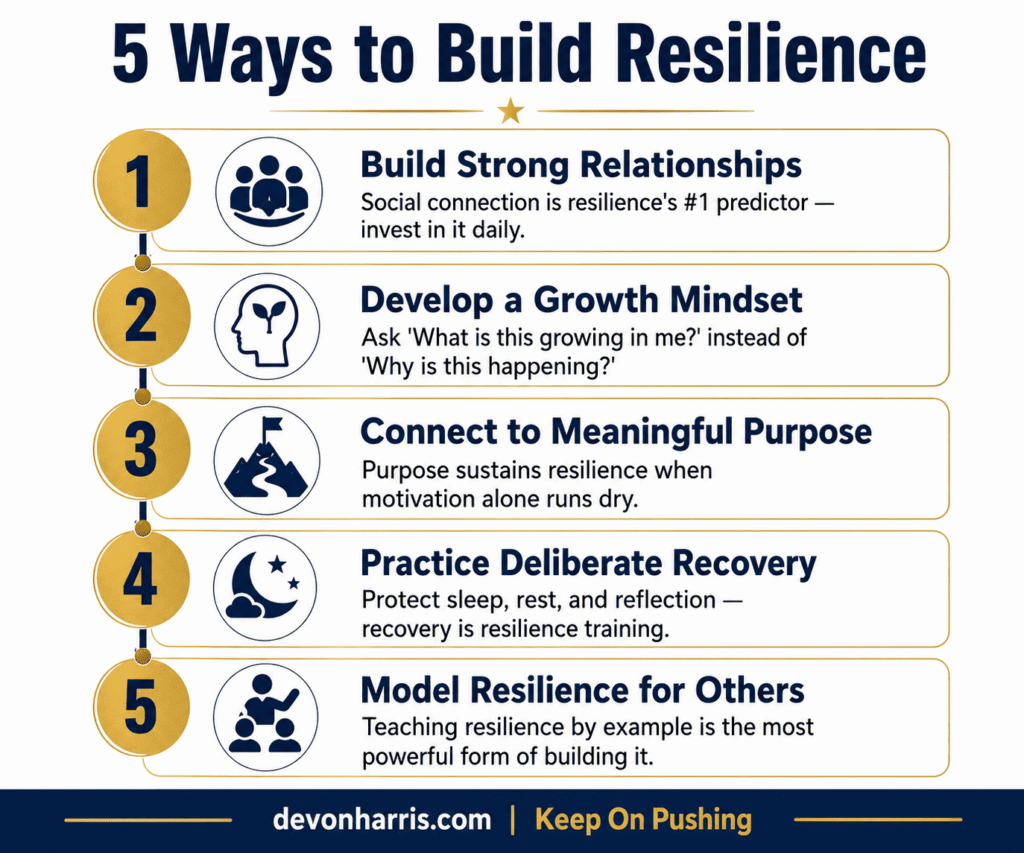
1. Build Strong Relationships
The single most consistent finding in resilience research is that social connection is its most powerful predictor. Furthermore, people with strong, trusting relationships recover from adversity faster, report higher wellbeing during difficulty, and are more likely to seek help when they need it. Therefore, investing in your relationships — especially during good times — is the most important resilience investment you can make. Moreover, this doesn’t require a large social network — the depth of a few genuine connections matters far more than the breadth of many superficial ones.
2. Develop a Growth Mindset About Adversity
Carol Dweck’s research on growth mindset applies directly to resilience — people who believe their capacity to handle difficulty can grow actually develop greater resilience than those who see their capacity as fixed. Furthermore, the practical implication is simple: when you face a challenge, deliberately ask yourself “What is this growing in me?” rather than “Why is this happening to me?” Moreover, this reframe doesn’t minimize the difficulty — it redirects your cognitive energy from passive suffering to active growth, which is precisely what building resilience requires. This is exactly the approach I explore in detail in my post on reframing challenges as opportunities.
3. Build Resilience at Work Through Purpose
One of the most effective ways to build resilience at work is to connect your daily tasks to a purpose larger than the task itself. Furthermore, research from the University of Michigan shows that people who feel their work is meaningful demonstrate significantly higher resilience during organizational change, leadership transitions, and professional setbacks. Therefore, if you are struggling with career resilience, start by asking: what is the deeper reason this work matters? And if you cannot find a meaningful answer, that may itself be the most important signal available to you.
4. Practice Deliberate Recovery
Resilience is not built only during adversity — it is built during recovery. Furthermore, how you treat yourself after a setback determines how quickly and how fully you return to capacity. Therefore, deliberate recovery means protecting sleep, maintaining physical movement, creating space for genuine rest, and processing difficulty through reflection rather than suppression. Moreover, each recovery period — handled intentionally — is training for the next challenge, building the psychological strength that makes future adversity more manageable.
5. Develop Resilience in Children Through Modeling
If you are a parent, coach, or mentor, one of the most powerful ways to build resilience in the next generation is to model it yourself. Furthermore, children learn resilience not primarily from being protected from difficulty but from watching trusted adults navigate difficulty with composure, honesty, and forward movement. Therefore, when you handle your own setbacks with deliberate resilience — and talk about it openly — you give the young people in your life something more valuable than any lesson you could teach directly.
What Is Resilience? The Final Word
Resilience is not a destination you arrive at. Furthermore, it is not a quality you either have or don’t. Instead, what is resilience at its core is simply this: the practiced choice to recover, adapt, and keep moving forward — no matter what. Moreover, every time you make that choice, however imperfectly, you strengthen the capacity to make it more easily next time.
On that bobsled track in Calgary, facing impossible odds with a team the world dismissed, we didn’t know if we would succeed. However, we knew we would not let adversity be the final word. That is resilience. Furthermore, it is available to you — right now, exactly as you are, wherever you are starting from.
Keep On Pushing!
Frequently Asked Questions About Resilience
What is resilience in simple terms?
In simple terms, resilience is the ability to recover from difficulty and keep moving forward. Furthermore, it doesn’t mean you won’t be affected by adversity — it means you won’t be permanently stopped by it. Moreover, resilience is a skill that can be developed at any age through deliberate practice, strong relationships, and a growth-oriented mindset toward challenges.
What are some examples of resilience in everyday life?
Examples of resilience in everyday life include recovering from job loss and finding new direction, rebuilding your sense of self after a relationship ends, persisting through repeated failure toward a meaningful goal, adapting to health challenges without losing a sense of purpose, and seeking help during difficult periods rather than suffering in silence. Furthermore, resilience doesn’t have to look dramatic — choosing to get up and try again after a disappointment is one of the most genuine examples of being resilient that exists.
What are the signs of resilience in a person?
Signs of resilience include recovering from setbacks without being permanently defined by them, tolerating discomfort and uncertainty without immediately seeking escape, asking “What can I do about this?” more naturally than “Why me?”, seeking support when needed, finding meaning in difficult experiences, and adapting strategies when current approaches stop working. Moreover, you can be genuinely resilient without feeling resilient — the behavior patterns matter more than the internal feeling in any given moment.
What is the difference between resilience and resistance?
Resistance means refusing to be affected by difficulty — trying to avoid, block, or deny the impact of adversity. Resilience, however, means being affected by difficulty and recovering from it. Furthermore, resistance is ultimately unsustainable because adversity is inevitable. Resilience, on the other hand, is a genuinely durable strategy because it doesn’t require difficulty to stop existing — it only requires you to keep moving through it.
How do you build resilience?
You build resilience through five core practices: investing in strong, trusting relationships; developing a growth mindset that sees adversity as building capacity rather than revealing limitation; connecting your work and goals to meaningful purpose; practicing deliberate recovery after setbacks through rest, reflection, and self-compassion; and modeling resilient behavior for others, especially children. Furthermore, resilience is built incrementally through small daily choices — not through a single dramatic act of willpower — so consistency matters far more than intensity.