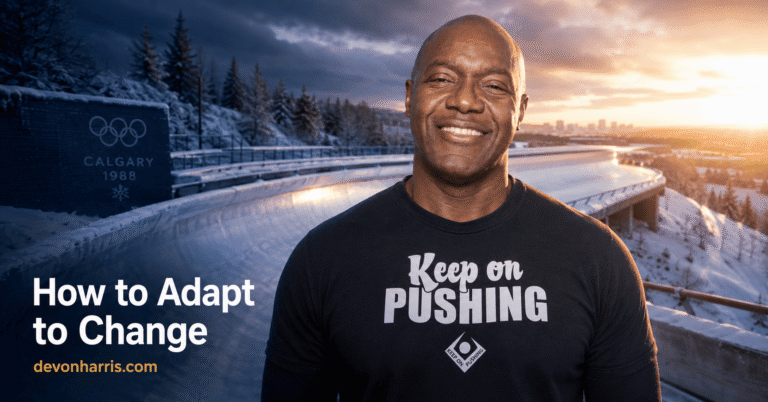
How to Adapt to Change: Lessons From an Olympic Underdog
Learn how to adapt to change with Olympic athlete Devon Harris. Discover 3 core capabilities that build resilience and adaptability .

Every person who has ever achieved something meaningful has a story about failure. Furthermore, the difference between those who succeed and those who don’t isn’t the absence of failure — it’s how they choose to embrace challenges rather than run from them. Challenges are an inevitable part of life. From personal setbacks to professional hurdles, each of us will face moments that test our resolve, stretch our capabilities, and push us beyond our comfort zones.
However, here is the truth that changes everything: while many people view challenges as roadblocks, you can also see them as opportunities for growth, learning, and transformation. Therefore, when you learn to see obstacles as opportunities, the key lies entirely in how you choose to approach them. This article will show you exactly how to embrace challenges, build resilience through adversity, and turn every obstacle into fuel for your own growth.
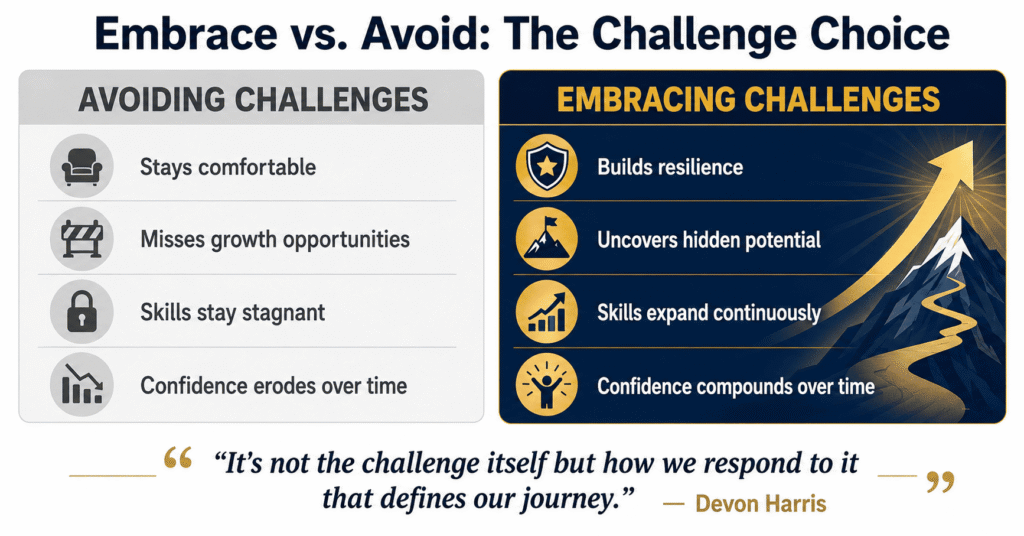
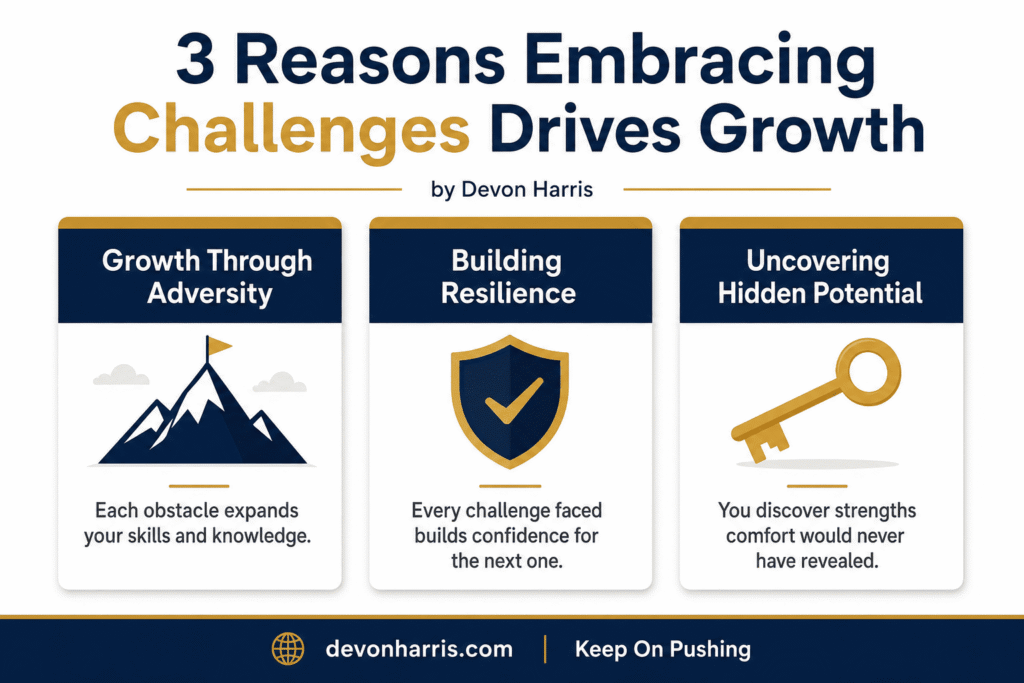
Before diving into how to embrace challenges effectively, it’s worth understanding exactly why this matters so much. Furthermore, there are three specific reasons why challenges are opportunities rather than threats — and why embracing them, rather than avoiding them, is essential for both personal and professional development.
Challenges force us to confront our limitations and expand our skills and knowledge. Each obstacle presents a chance to learn something new about ourselves, develop resilience, and grow stronger. Moreover, when we embrace challenges, we engage in a process of continuous improvement that is essential for long-term success. Growth through adversity isn’t a comforting cliché — it is a measurable pattern seen across nearly every successful person’s journey. Therefore, the question is never whether you will face adversity, but whether you will let it shrink you or grow you.
Every time you embrace challenges and persevere, you build mental and emotional resilience. This resilience becomes a foundation that helps you handle future difficulties with more confidence and composure. Furthermore, building resilience through challenges is backed by extensive research from the American Psychological Association, which confirms that resilience is not a fixed trait but a skill developed through repeated exposure to manageable adversity. By accepting obstacles as opportunities, you cultivate a mindset that views difficulty not as a threat but as a chance to build character and strength. This connects directly to what I explore in my post on embracing change as growth — because resilience and adaptability are built together, not separately.
It is also the core of my resilience keynote for teams.
Often, the obstacles we face reveal talents and abilities we did not know we possessed. By pushing ourselves beyond our comfort zone, we uncover hidden strengths and capacities that comfort alone would never have revealed. Moreover, we learn that we are capable of more than we initially believed — and this newfound confidence can propel us to achieve even greater things going forward. Therefore, every time you embrace challenges, you are also engaging in an act of self-discovery, not just an act of problem-solving.
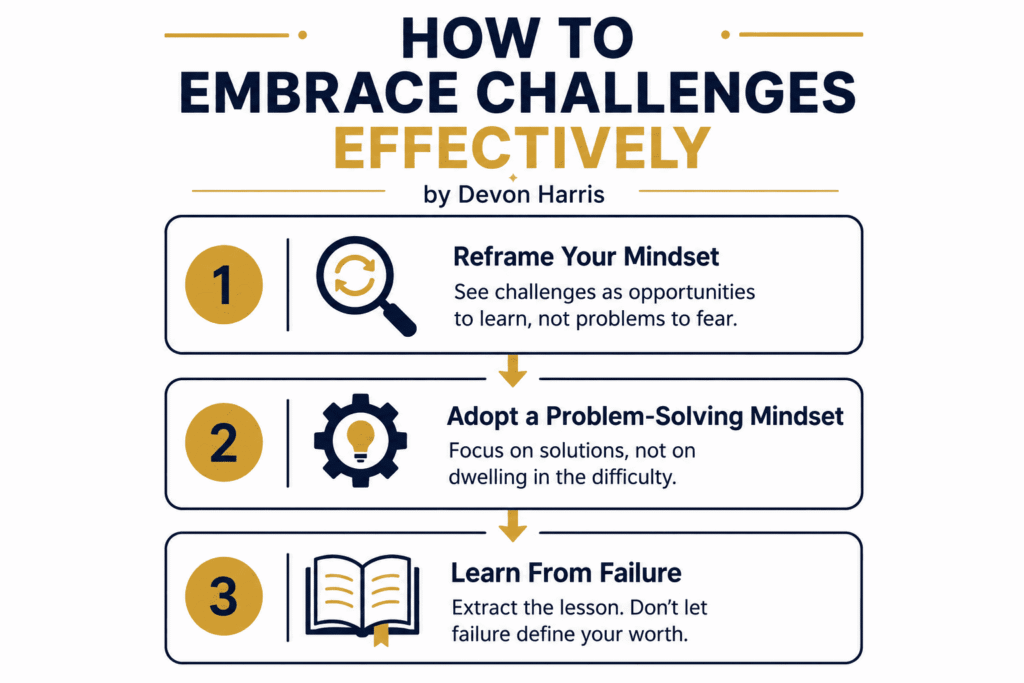
Knowing why you should embrace challenges is one thing. However, actually doing it consistently requires specific, practical strategies. Furthermore, here are the three approaches that make the biggest difference when turning challenges into opportunities in your own life:
Start by changing how you perceive challenges. Instead of seeing them as problems, view them as opportunities to grow. Cultivate a mindset that sees every challenge as a chance to learn something new — whether it’s a new skill, a different perspective, or a deeper understanding of yourself. Moreover, for deeper insights on this approach, Carol Dweck’s research on developing a growth mindset remains one of the most well-documented frameworks available. Therefore, the way you frame a challenge often determines the outcome before you’ve even started addressing it.
When faced with a challenge, focus on finding solutions rather than dwelling on the problem itself. Consider different strategies, evaluate potential outcomes, and remain willing to adapt and try new approaches. A genuine problem solving mindset shifts your energy from anxiety to action, which dramatically increases your chances of success. Furthermore, this proactive stance is precisely what separates those who get stuck when facing obstacles faced in daily life from those who move through them efficiently.
Not every challenge will be conquered on the first try, and that is completely okay. Instead, view failures as valuable learning experiences rather than verdicts on your worth or capability. Analyze what went wrong, understand why it happened, and use that knowledge to improve your approach moving forward. Learning from failure as part of your process builds resilience and helps you develop a genuine growth mindset over time. Moreover, this connects directly to my post on not fearing failure — because the fear of failing is often more limiting than failure itself.
Learning how to grow through challenges is not something that happens once and then stays with you forever. Instead, it is a lifelong practice — one that compounds every time you choose to embrace challenges rather than avoid them. Furthermore, the more you practice turning obstacle into opportunity in small ways, the more naturally you will respond to larger challenges when they inevitably arrive.
Personal growth through challenges follows a predictable pattern. First, you encounter resistance or difficulty. Then, you have a choice: retreat into comfort, or lean into the discomfort and extract the lesson available. Moreover, those who consistently choose the second option build what researchers call “stress inoculation” — a kind of psychological immunity that makes future challenges feel more manageable. Therefore, every challenge you embrace today is quietly preparing you for the challenges you haven’t met yet.
There will be moments when embracing challenges feels impossible — when motivation runs dry and the obstacle feels too large. In these moments, the goal isn’t to feel motivated. Instead, it’s to take one small action regardless of how you feel. Furthermore, how to deal with the obstacles you’ve faced during low-motivation periods comes down to lowering the bar for what counts as progress. A five-minute effort still counts. A single difficult conversation still counts. Therefore, momentum — not motivation — is what carries you through the hardest stretches of any challenge.
Embracing challenges is not about denying the difficulties or the discomfort they bring. It’s about acknowledging those feelings honestly while choosing to push through them anyway, leveraging every obstacle as a stepping stone toward growth and self-discovery. Furthermore, this distinction matters because toxic positivity — pretending hard things aren’t hard — actually undermines genuine resilience rather than building it.
Remember, it’s not the challenge itself but how you respond to it that defines your journey. The next time you encounter a challenge, see it for what it truly is — a chance to unlock your potential and become the best version of yourself. Moreover, embracing challenges, learning from failure, and building resilience aren’t separate skills. They are three expressions of the same underlying choice: to grow rather than shrink when life gets hard.
Keep On Pushing!
To embrace challenges means acknowledging that a difficulty is real and uncomfortable while choosing to engage with it constructively rather than avoiding it. It does not mean pretending the challenge is easy or denying the discomfort involved. Instead, it means viewing the obstacle as an opportunity for growth, learning, and self-discovery — and taking deliberate action to move through it rather than around it.
Challenges are opportunities because every obstacle forces you to develop a skill, perspective, or strength you didn’t previously have. The discomfort of a challenge is often the exact mechanism that produces growth — much like how physical resistance builds muscle. When you reframe an obstacle as an opportunity, you shift your energy from resistance to action, which is precisely where transformation happens.
Building resilience through challenges happens gradually, through repeated exposure to manageable difficulty rather than through one dramatic event. Start with smaller challenges and consciously notice how you recover from them. Over time, this builds what psychologists call stress inoculation — a kind of psychological strength that makes future obstacles feel more manageable. Moreover, surrounding yourself with people who model resilient responses to adversity significantly accelerates this growth.
Growing through challenges instead of being defeated by them starts with separating the facts of a situation from your interpretation of it. The facts are fixed — your interpretation is always a choice. Ask yourself what lesson this specific obstacle might be trying to teach you, then take one small action in that direction rather than continuing to dwell on the difficulty. Furthermore, momentum built through small consistent actions is what ultimately turns an obstacle into genuine personal growth.
When you feel like giving up, the most effective strategy is to lower the bar for what counts as progress rather than waiting to feel motivated again. Commit to a small, specific action — even five minutes of effort — rather than requiring yourself to fully solve the obstacle in one sitting. Furthermore, momentum built through small consistent actions reliably restores motivation over time, while waiting for motivation to return before acting often leads to prolonged inaction.
Devon tailors every keynote to your audience, your theme and the challenge in front of them.
Learn how to adapt to change with Olympic athlete Devon Harris. Discover 3 core capabilities that build resilience and adaptability .
Learn how to focus on the solution not the problem with Devon Harris. The Olympic mindset shift that turns every obstacle into an opportunity.
Devon Harris shares Olympic lessons on staying positive during hard times and finding real growth inside the struggle.