
Before the Jamaican bobsled team ever touched a real sled, we had already raced — in our minds. Every push, every corner, every fraction of a second was rehearsed in our imagination hundreds of times before it happened in reality. What we were doing, without knowing its scientific name, was exactly what elite athletes, world-class performers, and the most successful people in business all do: we were learning how to visualize — and using that skill to close the gap between where we were and where we needed to be.
The power of visualization is not a motivational myth or a self-help cliché. Furthermore, it is one of the most well-researched performance tools available to any human being — and it is available to you right now, for free, in any moment of your choosing. Therefore, this guide will show you exactly what visualization is, the science behind why it works, and the specific techniques you can use to start turning your dreams into reality starting today.
What Is Visualization and How Does It Work?
At its core, visualization is the practice of creating detailed, vivid mental images of a desired outcome — seeing yourself achieving a goal, performing a skill, or experiencing a future you are working toward. Furthermore, positive visualization is not simply wishful thinking. It is a deliberate cognitive practice that activates the same neural pathways as actual physical experience.
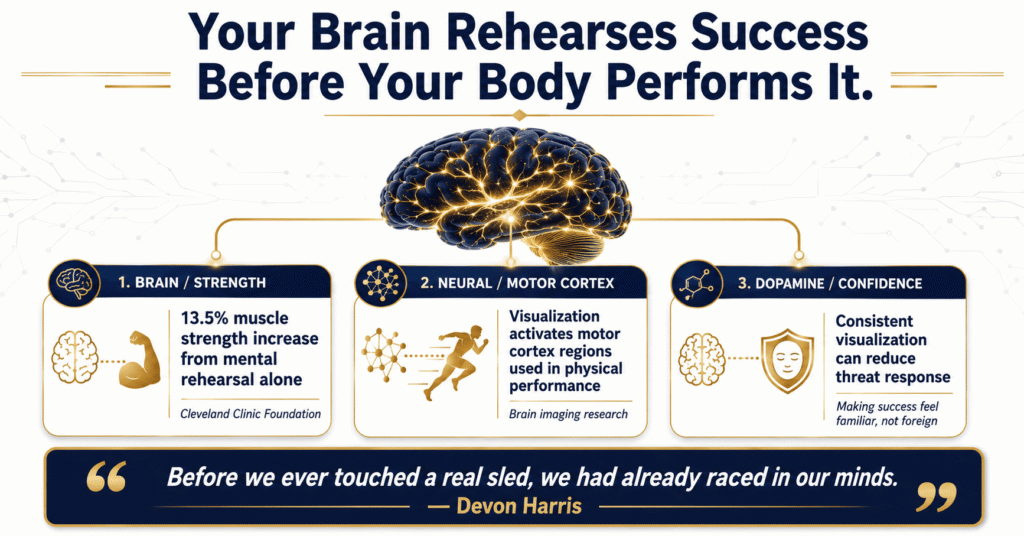
The science behind visualization is compelling and well-established. Research from the Cleveland Clinic Foundation found that people who mentally rehearsed physical exercises increased muscle strength by 13.5% — without moving a single muscle. Moreover, brain imaging studies consistently show that vividly imagining an action activates the same motor cortex regions as actually performing that action. Therefore, when you practice mental rehearsal consistently, your brain is literally building the neural architecture for the performance you want to deliver.
What Is Positive Visualization?
The positive visualization definition is the deliberate practice of mentally rehearsing desired future outcomes in vivid, sensory detail — with the emotional experience of already achieving them. Furthermore, positive visualization is distinguished from generic daydreaming by two key elements: specificity and emotional engagement. Moreover, the more precisely you can see, hear, and feel the experience of your goal already accomplished, the more powerfully your brain responds to the rehearsal. Therefore, positive visualization is not passive fantasy — it is active mental training with measurable neurological effects.
Visualization and the Brain
When you visualize vividly, your brain releases many of the same neurotransmitters it would release during the actual experience. Furthermore, this includes dopamine — the reward chemical — which reinforces motivation and forward movement toward your goal. Moreover, consistent positive visualization also reduces amygdala activation, which means your brain begins to perceive the desired outcome as familiar and achievable rather than threatening or out of reach. Therefore, the more you visualize success, the more your nervous system treats success as your default expectation — rather than an exception.
The Benefits of Visualization — Why It Actually Works
The benefits of visualization extend far beyond athletic performance. Furthermore, research across psychology, neuroscience, and organizational behavior consistently confirms that regular visualization practice produces measurable improvements across multiple domains of life. Here are the most significant:
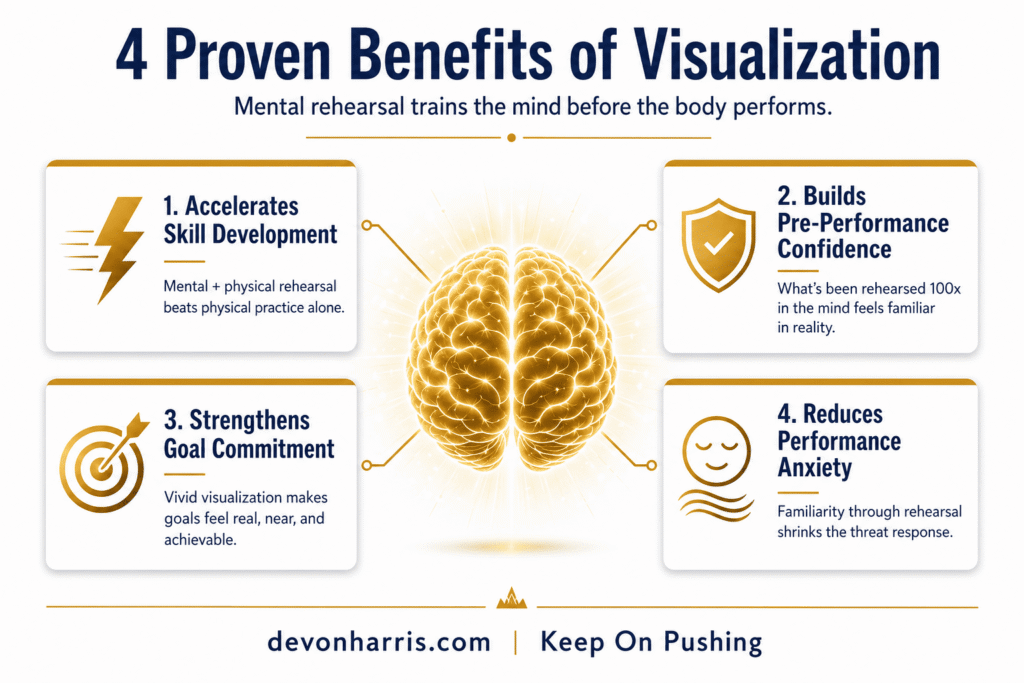
1. Accelerates Skill Development
Mental rehearsal activates the same neural pathways as physical practice. Furthermore, this means visualization supplements real-world practice rather than replacing it — and the combination of mental and physical rehearsal consistently outperforms physical practice alone. Therefore, whether you are learning a new skill, preparing for a presentation, or refining a craft, adding visualization to your practice routine accelerates your development curve measurably.
2. Builds Confidence Before Performance
One of the most powerful benefits of visualization is the confidence it builds before a high-stakes moment. Moreover, when you have mentally rehearsed a successful outcome hundreds of times, the actual performance feels familiar rather than foreign. Therefore, your nervous system responds with composure rather than anxiety — because at a neurological level, you have already been there before.
3. Strengthens Goal Commitment
Consistently visualizing your goals makes them feel more real, more achievable, and more personally meaningful. Furthermore, this increased psychological proximity to the goal strengthens your commitment to it — making you more likely to persist through the inevitable obstacles and setbacks along the way. Moreover, visualization techniques for manifestation work precisely through this mechanism: not through mystical means, but through the very practical process of increasing your emotional investment in the outcome and your behavioral commitment to achieving it. This connects directly to what I explore in my post on setting effective goals with the SMART framework — because visualization and goal setting are most powerful when practiced together.
4. Reduces Performance Anxiety
Visualization techniques for anxiety work by familiarizing your nervous system with the feared situation in a controlled, safe context. Furthermore, repeated positive visualization of a nerve-wracking scenario gradually reduces the threat response your body associates with it. Therefore, athletes, performers, speakers, and executives all use visualization to systematically reduce the anxiety that would otherwise undermine their performance at critical moments.
How to Visualize: A Step-By-Step Practice
Knowing the power of visualization is one thing. However, knowing how to visualize effectively is what separates people who get results from people who dismiss it as abstract. Furthermore, the difference between effective visualization and mere daydreaming comes down to five specific elements. Therefore, here is the exact process to follow:
Step 1: Create a Quiet Space
Effective visualization requires a few minutes of genuine stillness. Furthermore, find a quiet location where you won’t be interrupted — even five minutes is sufficient for a powerful practice. Close your eyes, take three slow deep breaths, and allow your nervous system to shift from reactive to receptive. This is the foundation on which everything else is built.
Step 2: Define the Scene With Precision
Vague visualization produces vague results. Instead, define every detail of the scene you want to inhabit. Moreover, where are you? What time of day is it? Who else is present? What are you wearing? What sounds do you hear? The more specific and sensory-rich your mental image, the more powerfully your brain responds to the rehearsal. Therefore, invest real time in building a vivid, detailed scene rather than settling for a blurry impression of success.
Step 3: Engage Your Emotions Fully
The emotion is the key ingredient that separates effective positive visualization from passive daydreaming. Furthermore, as you hold your mental image, consciously generate the feelings you would experience in that moment — pride, confidence, gratitude, joy, relief. Moreover, your brain responds to emotional signals more powerfully than visual ones alone. Therefore, feel the achievement as though it is already real — because neurologically, you are creating the experience in the very real tissue of your nervous system.
Step 4: See Yourself Succeeding in the Process, Not Just the Outcome
Research from UCLA found that students who visualized the process of studying — sitting down, opening books, working through problems — outperformed those who only visualized receiving a good grade. Furthermore, process visualization builds the behavioral commitment and planning that outcome visualization alone does not. Therefore, the most effective positive visualization techniques combine both: see yourself doing the work, and see yourself reaping the reward.
Step 5: Practice Daily With Consistency
A single visualization session creates a single neural impression. Furthermore, daily practice creates a neural pathway — a habitual mental route toward the outcome you are seeking. Therefore, commit to five to ten minutes of deliberate visualization every day, ideally at the same time — morning is particularly effective because your mind is most receptive immediately after waking. Moreover, like any skill, the results of visualization compound with consistency — the practice becomes more vivid, more emotionally engaging, and more neurologically effective the more you do it.
Sports Visualization: How Olympic Athletes Use Mental Rehearsal
Sports visualization has been a core component of elite athletic preparation for decades. Furthermore, virtually every Olympic program in the world now incorporates formal mental rehearsal training alongside physical conditioning. Moreover, the research consistently shows that athletes who add systematic visualization to their training outperform those who rely on physical practice alone.
For our Jamaican bobsled team, mental rehearsal was not optional — it was essential. We had less track time, less equipment access, and less institutional support than almost every other team at the 1988 Winter Olympics. However, what we could do anywhere, anytime, for free, was visualize. Therefore, we rehearsed our push start, our body positions, our breathing, our responses to difficult corners — all in our minds — thousands of times before we ever competed. Furthermore, that mental preparation closed a significant portion of the gap that our limited physical preparation could not. Therefore, on February 14, 1988, when we stood at the top of that Calgary track, our bodies were performing a run our minds had already completed hundreds of times. If you want to go deeper on the mindset that powers this kind of preparation, my post on the Olympic mindset for everyday life is the natural companion to this one.
Visualization Meditation: Combining Stillness With Mental Rehearsal
Visualization meditation combines the neurological benefits of mindfulness practice with the performance benefits of positive visualization — creating one of the most powerful mental training tools available. Furthermore, while traditional meditation focuses on clearing the mind, visualization meditation focuses on intentionally filling it with specific, desired imagery.
To practice visualization meditation, begin with five minutes of focused breathing to settle your nervous system. Moreover, once you feel genuinely still, introduce your visualization — your goal, your performance, your desired outcome — and hold it with both clarity and emotional presence for five to ten minutes. Furthermore, close the practice with a moment of gratitude for the outcome as though it has already occurred. Therefore, this closing gratitude deepens the emotional reinforcement and makes the visualization neurologically stickier — meaning the mental pathways it builds are more durable and accessible when you need them most. This practice connects powerfully to what I explore in my post on the power of pause and self-reflection — because visualization is most effective when the mind is genuinely still.

Start Visualizing Your Success Today
The power of visualization is not reserved for Olympic athletes or elite executives. Furthermore, it is a skill available to anyone willing to invest five minutes of daily practice. Moreover, the research is unambiguous: people who visualize consistently achieve more, perform better under pressure, and maintain stronger commitment to their goals than those who don’t.
Start tonight. Before you sleep, take five minutes to visualize one specific goal in vivid, emotional detail. See yourself succeeding. Feel what it feels like. Do it again tomorrow morning. Furthermore, build that practice day by day — and watch how the gap between where you are and where you want to be begins to close, not just in your mind, but in your measurable, real-world results.
Your dreams are not too big. You simply have not yet rehearsed them enough.
Keep On Pushing!
Frequently Asked Questions About Visualization
What is positive visualization?
Positive visualization is the deliberate practice of mentally rehearsing desired future outcomes in vivid, sensory detail — with the emotional experience of already achieving them. Furthermore, it is distinguished from ordinary daydreaming by specificity and emotional engagement. The more clearly you can see, hear, and feel a desired outcome, the more powerfully your brain responds to the mental rehearsal — building the neural pathways that make the imagined outcome progressively more achievable in reality.
How do you visualize effectively?
Effective visualization requires five elements: a quiet space free from distraction, a precisely defined scene with sensory detail, full emotional engagement with the feelings of success, process visualization alongside outcome visualization, and daily consistent practice. Furthermore, the most common mistake people make is visualizing vaguely — a blurry impression of success rather than a detailed, emotionally vivid scene. Therefore, invest real time in the specifics of your mental image and the quality of your emotional engagement with it.
Does visualization actually work?
Yes — and the evidence is substantial. Research from the Cleveland Clinic Foundation showed that mental rehearsal of physical exercises increased muscle strength by 13.5% without any physical movement. Furthermore, brain imaging studies consistently show that vivid visualization activates the same motor cortex regions as actual physical performance. Moreover, studies across sports psychology, academic performance, and business consistently show that people who visualize consistently outperform those who rely on action alone.
How does sports visualization work?
Sports visualization works by using mental rehearsal to build the same neural pathways that physical practice builds — but without the physical cost of fatigue, injury risk, or time constraints. Furthermore, elite athletes use visualization to rehearse technical movements, build pre-competition confidence, reduce performance anxiety, and mentally prepare for specific competitive scenarios they are likely to face. Moreover, research consistently shows that the combination of mental and physical rehearsal produces better performance than physical practice alone.
Can visualization help with anxiety?
Yes. Visualization techniques for anxiety work by gradually familiarizing your nervous system with anxiety-provoking situations in a controlled, safe mental environment. Furthermore, repeated positive visualization of feared scenarios progressively reduces the threat response your body associates with them — making the actual situation feel less threatening when it arrives. Therefore, visualization is used by therapists, coaches, and performance psychologists as one of the most effective tools for managing performance anxiety in athletes, speakers, executives, and anyone facing high-stakes situations.